Few instruments earn a permanent spot on nearly every surgical tray. The Allis tissue forceps is one of them. Whether you are stocking a new operating room, replacing worn instruments, or training a surgical technologist, knowing how Allis forceps work, which type to pick, and how to care for them makes a real difference in the OR.
This guide covers what Allis forceps are, what they are used for, the main types and sizes, how they differ from Babcock forceps, and how to sterilize them correctly.
What is an Allis Tissue Forceps?
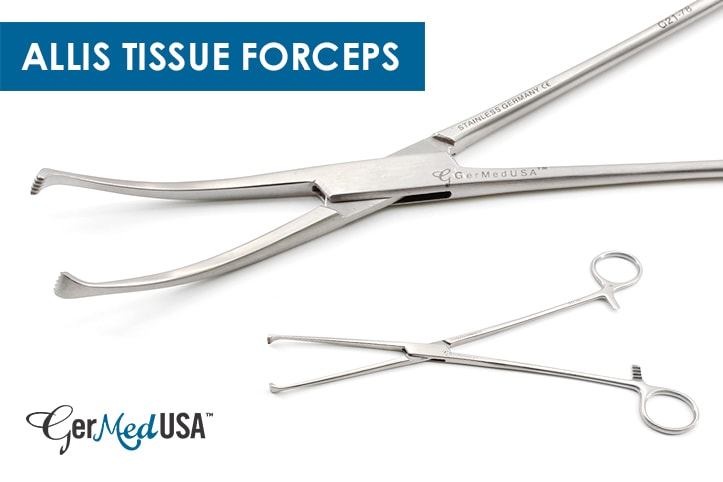
An Allis tissue forceps, also called an Allis clamp, is a ratcheted surgical instrument designed to grasp and hold dense or thick tissue firmly. It is named after Dr. Oscar H. Allis, the American surgeon who introduced the design. More than a century later, the instrument remains largely unchanged, which says a lot about how well it works.
Other names: Allis clamp, Allis forceps, and Allis tissue holding forceps.
A few simple design details give Allis forceps their characteristic grip and handling:
- Interlocking teeth: Fine teeth at the tips of the jaws fit together when the forceps close. They hold tissue firmly and provide a secure grip without relying only on pressure.
- Ratcheted ring handles: The finger rings feature a ratchet lock that keeps the jaws closed once the tissue is grasped. This lets the surgeon release their hand while the forceps stay in place.
- Box lock joint: The two halves meet at a box lock, which helps keep the jaws aligned and allows the instrument to open and close smoothly.
- Surgical-grade stainless steel: High-quality Allis forceps are made from stainless steel that stands up to repeated sterilization and regular use while maintaining the instrument's shape and function.
The overall effect is an instrument that grips firmly, stays put, and gives the surgeon a stable point of traction.
What Are Allis Forceps Used For? (Uses and Function)
Allis forceps are used to grasp, hold, and retract dense or thick tissue, such as fascia, bowel edges, and breast tissue, so the surgeon has a firm, stable hold while cutting, suturing, or exposing a site.
The main function of Allis forceps is traction. The interlocking teeth grip the tissue, and the ratchet keeps the jaws closed so the surgeon does not have to maintain pressure by hand. That is the purpose behind most Allis forceps uses, whether the goal is lifting a tissue layer, holding an edge for suturing, or pulling tissue out of the way. With the tissue secured, one hand stays free for the next step.
The use of Allis forceps varies by specialty:
- General Surgery: Surgeons commonly use Allis forceps in general surgeries to hold fascia, tendons, and the edges of bowel during anastomosis. They are also useful for lifting tissue layers while incisions are made and closed.
- Orthopedics: In orthopedic procedures, Allis forceps help retract tough, fibrous tissue and hold soft tissue structures out of the way while the surgeon works on deeper anatomy.
- Gynecology: Allis forceps are used to grasp the cervix and uterine tissue. In many procedures they are a less traumatic choice than a tenaculum, since the fine teeth spread the grip across a wider area of tissue.
- Breast Surgery: Surgeons rely on Allis clamps to hold and elevate breast tissue and skin flaps, giving a secure hold on the fibrous and fatty tissue that can be slippery to manage.
Across all of these Allis forceps uses, the pattern is the same. Where the tissue is dense and a firm, dependable hold is needed, the Allis clamp is a strong choice.
Are Allis Tissue Forceps Still Used?
Yes. Allis tissue forceps are still a familiar part of surgical trays around the world, including in modern operating rooms with advanced equipment.
The same basic idea has also made its way into minimally invasive surgery. Laparoscopic Allis graspers use toothed jaws to hold tissue securely, but the instrument is designed to pass through small surgical ports.
The design has changed to fit modern procedures, but the basic principle remains the same: a firm, reliable grip when tissue needs to be held in place.
So why have they not been replaced? Mostly because nothing else matches their grip on dense tissue at this price and level of simplicity. Newer instruments handle specific tasks well, but for firm traction on tough tissue, the classic Allis clamp is still hard to beat.
Types of Allis Tissue Forceps
Not every procedure needs the same Allis clamp. Jaw shape, tooth count, and length can vary based on the tissue being handled and the surgical site. Here are the main types to know.
Baby Allis Tissue Forceps
A compact, extra delicate version built for smaller structures and finer work. The reduced size gives better control where a full-size clamp would be too bulky.
Allis Adair Tissue Forceps
This features a 9×10 teeth configuration and a wider grip. It spreads holding pressure over a larger area, which makes it well suited to broader tissue surfaces such as breast tissue.
Judd Allis Tissue Forceps
This has narrow jaws and sharp teeth. The slim profile makes it a good pick when space is tight and a precise, firm hold is needed.
Thoms Allis Tissue Forceps
It comes with a 6×7 teeth pattern and an 8" length, giving surgeons the reach to work in deeper sites while keeping a secure grip.
Pedifine Allis Tissue Forceps
A 4×5 teeth configuration in 4¾" and 5¾" lengths, designed for pediatric patients and small cavities, where gentler handling is important.
Color-Coated Allis Tissue Forceps
They are functionally the same as standard Allis clamps, but with a color coating that makes identification quick and easy in the OR. This helps with instrument counts, tray organization, and telling similar instruments apart at a glance.
Choosing the right type comes down to the tissue involved, the depth of the surgical site, and how much delicacy the procedure requires.
What Are the Different Sizes of Allis Tissue Forceps?
Allis forceps range from about 4¾" to 10" in length. Teeth configurations typically run from 3×4 up to 6×7, with the Allis Adair as an exception at 9×10. The first number is the count of teeth on one jaw, and the second is the count on the opposing jaw, so they interlock when closed.
Length affects reach. Tooth count affects how the grip is distributed. Fewer teeth concentrate pressure at fewer points, while more teeth spread it out.
Here is a quick reference:
|
Size |
Teeth |
Best For |
|
4¾" to 5¾" |
4×5 (Pedifine) |
Pediatric, small cavities, superficial tissue |
|
6" |
3×4 / 4×5 / 5×6 |
General surgery, gynecology |
|
7½" |
4×5 / 5×6 |
Deeper surgical sites |
|
8" |
6×7 (Thoms) |
Deep sites |
|
10" |
5×6 (Allis Willauer) |
Deep cavity, abdominal retraction |
As a rule of thumb, go shorter and more delicate for superficial or pediatric work, and go longer with more teeth for deep abdominal procedures where both reach and a broad hold matter.
Allis Tissue Forceps vs. Babcock Forceps
Surgeons often reach for either an Allis or a Babcock forceps for a number of surgeries, and the two are easy to confuse. Both are ratcheted tissue forceps, but they function very differently.
- Allis forceps have interlocking teeth. They give a firm, secure grip, but that grip is more traumatic to tissue.
- Babcock forceps have smooth, rounded, fenestrated jaws. They are atraumatic, holding delicate structures such as the bowel, fallopian tubes, and ureters gently without damaging them.
The key rule is easy to remember. If the tissue must remain viable after you release it, use a Babcock. If the tissue is being excised, or you need firm traction on dense structures, use an Allis.
For a deeper side-by-side breakdown, read our full guide on Allis tissue forceps vs. Babcock forceps.
How to Sterilize Allis Forceps
Proper reprocessing protects patients and extends the life of your instruments. The ring handles, box lock, and interlocking teeth all trap debris easily, so each step matters.
1. Initial Cleaning:
Start with a manual scrub or an enzymatic soak as soon as possible after use. Do not let blood and tissue dry on the instrument. Pay close attention to the box lock and between the teeth, using a soft brush to reach tight spots. Rinse thoroughly afterward.
2. Sterilization:
Steam sterilization in an autoclave is the standard method. Run a standard cycle following your facility protocol and the instrument manufacturer's instructions. Make sure the forceps are in the open, unlocked position so steam can reach every surface, including the joint and teeth.
3. After Sterilization:
Once the instrument has cooled, inspect it thoroughly. Make sure the teeth line up and lock together properly and that the ratchet opens and closes smoothly. Look for any signs of rust, pitting, or cracks. Add a little instrument lubricant to the box lock if needed. Store the forceps in a clean, dry place or keep them in a sealed sterile pack until they are needed.
For complete instrument cleaning procedures, see our surgical instruments care and maintenance guide.
Allis Forceps FAQs
What is an Allis in surgery?
An Allis is a ratcheted tissue forceps with interlocking teeth, named after Dr. Oscar H. Allis. Surgeons use it to grip and hold dense tissue firmly during a procedure.
What are tissue forceps used for?
Tissue forceps are used to grasp, hold, and manipulate tissue so the surgeon can cut, suture, or expose an area. Toothed types such as Allis forceps give a firm grip on dense tissue, while smooth types such as Babcock forceps hold delicate structures with less trauma. Browse our full range of tissue forceps.
Is there an Allis retractor?
People searching for an “Allis retractor” are usually looking for Allis forceps. They are not a dedicated retractor, but surgeons use them to retract tissue by gripping it and holding it aside.
How do I choose the right Allis forceps size?
Go shorter and more delicate for superficial or pediatric work, and longer for deep abdominal procedures where reach matters. Check the size table above for tooth counts and lengths.
Why Choose GerMedUSA Allis Forceps?
When an instrument is used this often, quality shows quickly. Here is what you get with GerMedUSA:
- German surgical-grade stainless steel built for precision, durability, and repeated sterilization
- Customization available to match your facility's needs
- Multiple types and sizes in stock so that you can find the right forceps for each procedure
- Warranty and support from a team that stands behind its instruments
Ready to stock your trays with instruments you can count on? Browse our full range of Allis Tissue Forceps and find the right fit for your surgical team.