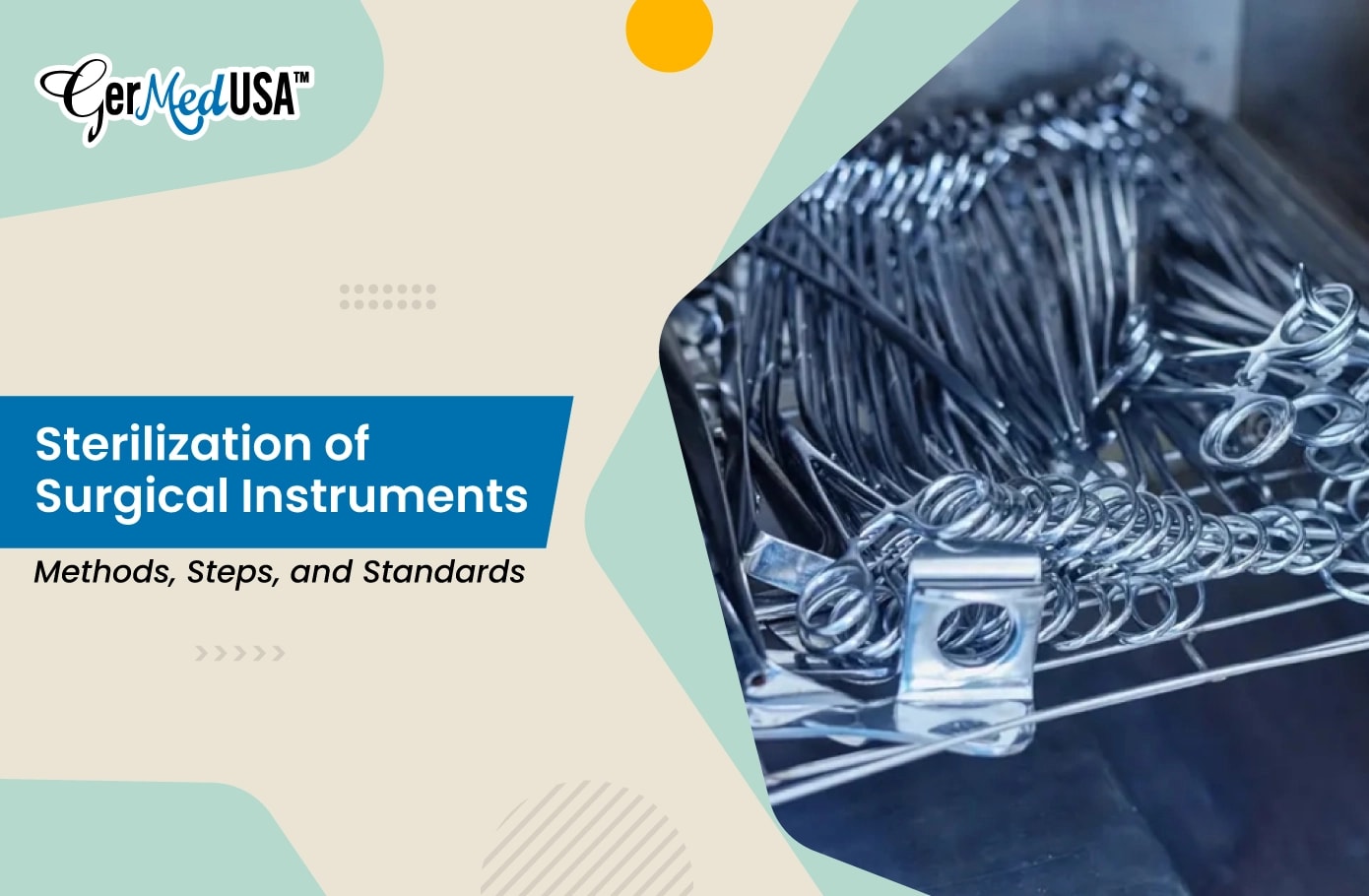
Surgical instruments are sterilized by cleaning and drying them thoroughly, followed by a validated sterilization cycle, most commonly steam autoclaving at 121 to 134°C.
Cleaning alone does not sterilize an instrument. Debris left behind can shield microorganisms from heat, steam, or chemical sterilants, meaning a load may appear to have completed the cycle but still fail to achieve sterilization.
This guide explains what sterilization eliminates and the standards used to validate sterilization cycles. It covers six main sterilization methods used in practice: steam, cold chemical, ethylene oxide, hydrogen peroxide plasma, dry heat, and radiation.
It also outlines the seven steps an instrument follows from point of use through sterile storage and examines common points of sterilization failure. Finally, it provides a brief history of how sterilization practices evolved into the validated cycles used today.
What Is Sterilization of Surgical Instruments?
The sterilization of surgical instruments is the complete elimination of all microbial life, including bacterial spores, from an instrument's surface. This differentiates sterilization from disinfection, which kills living microorganisms but is not reliably effective against bacterial spores, and cleaning, which removes apparent dirt and organic debris. These procedures are interrelated, and sterilization relies on proper cleaning beforehand. There can be no certainty of sterilizing an instrument if it is not adequately cleaned.
The question here is how medical staff determines whether an instrument needs cleaning, disinfection, or sterilization. The Spaulding classification provides the answer.
Spaulding Classification:
Spaulding classification sorts medical devices by the risk of infection tied to their intended use and infection risk.
- Critical Items: These include medical instruments that enter sterile tissue or the vascular system and require sterilization.
- Semi-critical Items: These items contact mucous membranes or non-intact skin and require at least high-level disinfection.
- Noncritical Items: These tools contact only intact skin and require cleaning followed by low-level disinfection.
Surgical instruments fall squarely into the critical category. Because they enter sterile tissue during a procedure, sterilization is not optional and disinfection is not an adequate substitute, regardless of how thoroughly an instrument has been wiped down or soaked.
Standards Governing Surgical Instrument Sterilization
Facilities do not set sterilization protocols from scratch. They build and validate them against a small set of recognized bodies, and citing the right ones matters for anyone researching this topic seriously.
CDC Guidance
The CDC publishes guidance on disinfection and sterilization in healthcare settings, offering evidence-based recommendations that hospitals and surgical practices use as a baseline for their own protocols.
AAMI ST79
AAMI ST79 is the comprehensive United States guidance document specific to steam sterilization in health care facilities, developed by AAMI with ANSI, covering cleaning, packaging, loading, cycle parameters, and quality monitoring.
AORN Guidelines
AORN publishes perioperative practice guidelines that address instrument handling in the operating room and in sterile processing.
How Facilities Apply These Standards
Facilities validate their own cycles against the standards and against each instrument's manufacturer instructions for use, or IFU.
GerMedUSA manufactures to ISO 13485, the quality management standard for medical device manufacturing.
Sterilization Methods for Surgical Instruments
There are four main types of sterilization: steam, dry heat, chemical, and radiation. In healthcare facilities, reusable surgical instruments are most often sterilized using steam, chemical methods, or dry heat. Steam is used for most metal instruments, while chemical sterilization, including gas and liquid methods, is used for items that cannot tolerate high temperatures. Dry heat is an option for materials that may corrode when exposed to steam.
Radiation sterilization is mainly used in industrial manufacturing rather than clinical settings, so it is covered separately below.
Steam Sterilization (Autoclaving)
Steam sterilization, or autoclaving, uses saturated steam under pressure to destroy microorganisms, including bacterial spores, by denaturing their proteins. It is the most widely used method for reusable surgical instruments because it is fast, leaves no chemical residue, and is well established against recognized standards.
The Three Phases of a Steam Cycle
A steam cycle runs through three phases:
- Conditioning, or air removal: This clears air from the chamber so steam can reach every surface.
- Exposure: It holds the load at the validated temperature and pressure for the required time.
- Drying: This removes residual moisture before handling, since a wet package is considered contaminated.
Gravity Displacement vs. Pre-Vacuum Cycles
Facilities manage the conditioning phase with one of two cycle types.
- Gravity displacement cycles: Incoming steam pushes air out through a drain. The process is simpler, but it takes longer and may not work as well for instruments with lumens.
- Pre-vacuum cycles: A vacuum pump removes air from the chamber before steam enters. This allows steam to reach instrument surfaces, lumens, and porous packaging more reliably and generally shortens the cycle time.
Temperature and Exposure Time for Steam Sterilization
Steam sterilization typically runs in a range of 121 to 134 degrees Celsius. The exact temperature and exposure time depend on the facility's validated cycle, the load, the packaging, and the instrument's own IFU and should never be treated as one fixed number for every case.
Instruments must be autoclaved fully open so steam reaches the box joint and blade faces, and the chamber should never be packed beyond its rated capacity, since a crowded load blocks the circulation the process depends on.
Cold Sterilization (Chemical Sterilants)
Cold sterilization uses liquid chemical sterilants instead of heat for instruments that cannot tolerate an autoclave cycle. It requires full immersion in an EPA-registered sterilant for the manufacturer's specified exposure time, measured in hours rather than the minutes typical of a steam cycle.
This differs from using the same chemical as a high-level disinfectant, which uses a shorter exposure time and does not reliably eliminate spores. Repeated exposure to chemical sterilants can also wear down fine instruments over time, affecting their sharp edges and making hinges less smooth. For this reason, chemical sterilization is generally reserved for instruments that cannot tolerate heat-based sterilization.
Ethylene Oxide (EO) Sterilization
Ethylene oxide is a gas sterilant for heat- and moisture-sensitive items. Because EO gas is toxic, instruments require an extended aeration period after the cycle to let residual gas dissipate before handling, which significantly extends total turnaround compared with steam.
Hydrogen Peroxide Plasma Sterilization
Hydrogen peroxide plasma sterilization runs at low temperature and completes faster than EO, which makes it a practical alternative for many heat-sensitive instruments. It has real limits, though, including restrictions on long, narrow lumens and incompatibility with certain absorbent materials.
Dry Heat Sterilization
Dry heat uses hot air rather than moist steam, which suits materials steam would corrode or cannot penetrate, such as certain oils and powders. Because dry heat lacks the penetrating efficiency of moist heat, it needs longer cycle times and higher temperatures than steam to reach the same result.
Radiation Sterilization
Radiation sterilization uses gamma rays or an electron beam to destroy microorganisms. This is an industrial method performed at a manufacturing scale for single-use devices, not a method available in clinical facilities or sterile processing departments. It has no role in reprocessing reusable surgical instruments between procedures.
Important - Why Boiling Is Not Sterilization
Boiling water at 100 degrees Celsius kills most vegetative bacteria, but it does not reliably destroy bacterial spores, and destroying spores is the specific line that separates sterilization from disinfection. Boiling is sometimes described as a field or emergency measure to use when no proper alternative exists. It does not meet the standard required for any instrument entering sterile tissue and should never be treated as a substitute for a validated sterilization cycle.
Comparing Sterilization Methods
|
Method |
Temperature |
Typical Cycle Time |
Best For |
Limitations |
|
Steam (autoclave) |
121 to 134°C |
About 3 to 4 minutes of exposure for pre-vacuum cycles, or 15 to 30 minutes for gravity displacement cycles, plus drying |
Most reusable metal instruments |
Not suitable for heat- or moisture-sensitive materials |
|
Cold sterilization (chemical) |
Ambient |
Several hours of immersion |
Heat-sensitive instruments |
Long exposure can wear fine instruments over time. |
|
Ethylene oxide (EO) |
Low temperature |
Hours, plus extended aeration |
Heat- and moisture-sensitive items |
Long turnaround, toxic residual gas requires aeration. |
|
Hydrogen peroxide plasma |
Low temperature |
Shorter than EO |
Heat-sensitive instruments needing faster turnaround |
Limited with long lumens and some absorbent materials |
|
Dry heat |
Higher than steam |
Longer than steam |
Materials that steam would corrode. |
Long cycle, high heat exposure |
|
Radiation (gamma or e-beam) |
N/A, industrial |
Manufacturing scale |
Single-use devices |
Not a clinical or in-facility method |
The 7 Steps of Sterilizing Surgical Instruments
Sterilization is a sequence, and skipping or shortening any one of these seven steps compromises everything that follows it.
- Point-of-use rinsing and pre-cleaning. Blood, tissue, and other organic debris should be rinsed or wiped from an instrument as soon as possible after use, before it dries and hardens onto the surface. This is also what should precede sterilization of any minor surgical instrument: gross debris comes off first, every time.
- Cleaning, manual or ultrasonic. Instruments go through manual scrubbing or ultrasonic cleaning with an enzymatic cleaner, with attention to hinges, box joints, and serrations where debris hides. For a detailed walkthrough of this stage, see our guide to cleaning surgical instruments.
- Inspection and lubrication of hinged instruments. Each instrument is checked for remaining debris, damage, corrosion, and alignment. Hinged instruments, including needle holders, should be lubricated with a water-soluble surgical instrument lubricant, never an industrial or petroleum-based oil, which interferes with steam penetration.
- Drying. Instruments must be completely dry before packaging. Residual moisture can compromise the sterilization cycle and creates conditions for bacterial growth.
- Packaging and loading. Instruments are packaged and loaded open, not stacked, so the sterilizing agent can circulate around every surface. Overloading here is one of the most common points of failure.
- Sterilization cycle. The load runs through the facility's validated cycle, whether steam, EO, hydrogen peroxide plasma, dry heat, or cold chemical immersion, for the full time and temperature or exposure period the validation requires.
- Cooling, storage, and sterile handling. After the cycle, instruments cool and finish drying before moving to sterile storage and from that point forward should only be handled with sterile technique.
This same sequence applies in a small practice or a hospital's dedicated sterile processing department, though larger facilities run it at greater volume with more formal tracking at each step.
A Brief History of Surgical Instrument Sterilization
Reliable sterilization is a relatively recent development in surgery. Much of the progress that shaped modern sterilization took place during the second half of the nineteenth century.
In the 1840s, Ignaz Semmelweis noticed that deaths from puerperal fever in a Vienna maternity ward dropped sharply when physicians washed their hands with a chlorinated lime solution after working in the autopsy room and before entering the delivery room. He concluded that physicians were carrying infectious material from one patient to another. Although much of the medical community rejected his findings at the time, his work is now recognized as an early demonstration of how hand hygiene could reduce infection.
Over the following decades, Louis Pasteur's germ theory of disease provided an explanation for Semmelweis's observations. As microorganisms became recognized as a cause of disease, surgeons began looking for ways to prevent contamination instead of treating infection after it developed.
Joseph Lister brought these ideas into surgical practice. In 1867, he introduced carbolic acid antisepsis, using carbolic acid solutions on wounds and instruments to reduce postoperative infection. Lister is credited with introducing antiseptic technique to surgery, rather than inventing sterilization itself. His methods reduced contamination but did not achieve the complete elimination of microbial life that defines sterilization.
That distinction became clearer in the 1880s. Robert Koch's research demonstrated that saturated steam was more effective than dry heat at destroying bacterial spores, which are among the most resistant forms of microbial life. Around the same period, Charles Chamberland developed a pressurized steam sterilizer based on pressure vessel principles associated with Denis Papin's earlier steam digester. Chamberland's autoclave became an early predecessor of the steam sterilizers used in modern sterile processing departments.
From there, surgical practice gradually moved from antiseptic techniques toward aseptic practice and validated sterilization processes. Biological indicators and other monitoring methods made it possible to verify that a sterilization cycle had worked instead of simply assuming it had. Modern systems, including pre-vacuum autoclaves, hydrogen peroxide plasma systems, and peracetic acid-based sterilization, continue that progression.
The principle remains the same: sterilization needs to be demonstrated through a validated process, not assumed simply because an instrument has been processed.
10 Common Mistakes in Sterilization of Surgical Instruments
Even facilities with a documented protocol can fall into one of these ten mistakes in the sterilization of surgical instruments. Most trace back to a shortcut taken somewhere in the sequence above.
-
Inadequate Pre-Cleaning
Skipping or rushing pre-cleaning leaves organic debris on an instrument, and that debris can physically block a sterilizing agent from reaching the surface underneath it.
Problem: Residue shields microorganisms, sterility is compromised, and infection risk rises.
Solution: Use enzymatic cleaners, rinse thoroughly, follow a strict pre-cleaning protocol, and inspect for debris before the instrument goes into the sterilizer.
-
Using Incorrect Sterilization Methods
Different instruments and materials require different sterilization methods. Using the wrong one can damage the instrument, leave it inadequately sterilized, or both.
Problem: The instrument may be damaged, sterilization may be ineffective, and its usable lifespan shortens.
Solution: Follow manufacturer guidelines, match the method to the material, and train staff on which method applies to which instrument.
-
Overloading the Sterilizer
An overloaded sterilizer blocks the heat or airflow the cycle depends on, which can leave part of the load under-processed even though the cycle ran to completion.
Problem: Circulation is blocked, sterilization becomes uneven, and contamination risk increases.
Solution: Load the sterilizer to its rated capacity, avoid stacking instruments, and space items so air and steam can move around each one.
-
Incorrect Temperature and Pressure Settings
Every sterilization method has specific temperature and pressure requirements, and running a cycle outside those settings can make the process ineffective even when everything else was done correctly.
Problem: Bacteria or spores may survive, sterilization becomes inconsistent, and safety is compromised.
Solution: Verify settings before each run, follow standard guidelines for the method in use, and calibrate sterilizers on a regular schedule.
-
Ignoring Instrument Drying
Instruments left wet after sterilization create conditions for bacterial growth and risk recontamination before they are even stored.
Problem: Moisture supports bacterial growth, tools can corrode, and storage sterility is reduced.
Solution: Dry instruments completely before storage, only store fully dry tools, and monitor humidity in storage areas.
-
Improper Instrument Handling
Sterilized instruments need a sterile environment from the moment the cycle ends. Bare hands or a non-sterile surface can undo the entire process in seconds.
Problem: Bare hands and non-sterile surfaces reintroduce bacteria, and the sterilization effort is effectively wasted.
Solution: Handle sterile instruments with sterile gloves, maintain a sterile field, and use sterilized trays for transport.
-
Using Expired Sterilizing Agents
Chemical sterilants and other sterilizing agents lose potency past their expiration date, and an expired agent can leave an instrument only partially sterilized.
Problem: Reduced effectiveness means bacteria or spores may survive, and patient safety is compromised.
Solution: Check expiration dates regularly, replace outdated agents promptly, and use inventory tracking to catch expirations before they become a problem.
-
Skipping Biological Indicators and Testing
Biological indicators are what actually confirm a sterilization cycle worked. Without them, a facility is assuming success rather than verifying it.
Problem: Sterility goes unverified, contamination risk increases, and liability increases along with it.
Solution: Run spore tests on a regular schedule, monitor sterilizer performance, and keep documented records of every test result.
-
Improper Storage of Sterilized Instruments
Sterilized instruments stored in a poorly maintained or non-sterile environment can be recontaminated by dust or moisture even though the sterilization cycle itself was successful.
Problem: Contaminants reach the instruments, sterility duration is reduced, and accidental damage becomes more likely.
Solution: Use sealed, sterile storage, keep storage areas clean, and inspect them regularly.
-
Failure to Train and Educate Staff
Untrained staff are more likely to overlook a critical step or mishandle equipment, and most of the mistakes above trace back to a training gap somewhere in the process.
Problem: Knowledge gaps lead directly to errors, and errors raise infection risk.
Solution: Run regular training sessions, keep staff current on updated methods, and build in hands-on practice rather than relying on written protocols alone.
Chemicals That Damage Surgical Instruments
Stainless steel's corrosion resistance comes from a thin passive layer, usually a chromium or iron oxide layer, that protects the metal underneath. That layer resists most everyday exposure, but it is still vulnerable to certain chemicals and to mineral-heavy tap water, which is why rinsing with distilled water is standard technique, not an optional step.
Chemicals that can damage surgical instruments include:
- Hydrogen peroxide
- Alkaline-based cleaning solutions
- Dish soap or laundry soap
- Ammonia
- Bleach
- Iodine products
- Hydrochloric acid
This applies to precision instruments generally, including tungsten carbide instruments, where the tungsten carbide inserts and their solder joints can be particularly sensitive to the wrong cleaning chemistry. Before final sterilization, every instrument should be treated as though it is still contaminated and cleaned accordingly.
Care and Storage After Sterilization
Sterilization does not end when the cycle completes. Cooling and final drying happen before instruments are moved, and nothing should be handled or stored while residual moisture remains.
Storage conditions determine how long sterility actually holds. Wrapped sets or rigid containers need to stay in a clean, dry, low-traffic area, away from moisture and temperature swings that degrade packaging over time. The most common cause of corrosion at the box joint is storing an instrument closed and damp, so instruments should be stored open or in a position that lets trapped moisture escape rather than sit against the joint.
Most modern protocols treat sterility as event-related rather than tied to a fixed calendar date: a properly packaged, undisturbed set stays sterile until something happens to it, such as a torn wrap or a broken seal. Any of those events ends sterility immediately, regardless of how recently the set came out of the sterilizer.
FAQs
How long does it take to sterilize surgical instruments?
Steam autoclave cycles commonly run about 3 to 4 minutes of exposure for pre-vacuum cycles, or 15 to 30 minutes for gravity displacement cycles, before drying. Ethylene oxide and cold chemical sterilization take considerably longer, often several hours.
What temperature is needed to sterilize surgical instruments?
Steam autoclaving typically runs 121 to 134 degrees Celsius, with the exact figure set by the facility's validated cycle and the instrument's IFU. Low-temperature methods such as EO and hydrogen peroxide plasma operate well below that range for heat-sensitive items.
What is the difference between cleaning, disinfection, and sterilization?
Cleaning removes visible debris but does not kill microorganisms. Disinfection reduces microbial load without reliably eliminating spores. Sterilization is the complete elimination of all microbial life, including spores, and is the standard required for instruments entering sterile tissue.
Can surgical instruments be sterilized at home?
No. Boiling water or alcohol soaking can disinfect an instrument to some degree, but neither reliably destroys bacterial spores, which makes both inadequate for any instrument used in a clinical procedure.
How many times can a surgical instrument be sterilized?
There is no fixed universal number. A well-maintained, properly lubricated stainless steel instrument is designed for repeated sterilization across its full service life, provided it is inspected before each use and retired or serviced when damage appears. Service life depends on the steel grade, how often the instrument is used, and how closely cleaning and lubrication protocols are followed.
When did doctors start sterilizing surgical instruments?
Modern practice grew out of the antiseptic movement of the mid to late 1800s. Lister introduced carbolic acid antisepsis in 1867, Koch's 1880s research established steam as more effective than dry heat against spores, and Chamberland's pressurized autoclave, developed around the same period, became the ancestor of today's equipment.
What is AAMI ST79?
AAMI ST79 is the comprehensive United States guidance document covering steam sterilization and sterility assurance in health care facilities, developed by AAMI with ANSI. Facilities use it, alongside CDC and AORN guidance, to build and validate their own sterile processing protocols.
What is the best liquid to sterilize instruments?
No single liquid sterilizes on its own. Effective cold sterilization of surgical instruments requires an EPA-registered chemical sterilant, such as a glutaraldehyde or peracetic acid solution, used at the concentration and immersion time its manufacturer specifies.
How often should surgical instruments be sterilized?
Before every use, with no exceptions for critical devices. Sterilization is tied to use, not to a calendar interval, and a properly sterilized, wrapped set stays sterile only until its packaging is compromised.
How long do instruments stay sterile after autoclaving?
Shelf life depends on packaging and storage, not a fixed number of days. Intact, dry, properly sealed sets can remain sterile for an extended period under event-related sterility guidelines, but any tear, moisture, or seal failure ends sterility immediately.
What do surgeons use to sterilize instruments?
Most metal instruments go through steam autoclaving, since it is fast, validated, and leaves no residue. Heat-sensitive instruments use ethylene oxide, hydrogen peroxide plasma, or cold chemical sterilization instead, chosen by the instrument's material and the facility's protocol.
What happens when surgical instruments are not sterile?
Non-sterile instruments can introduce bacteria, viruses, or bacterial spores into a patient's tissue, leading to surgical site infections that range from minor complications to life-threatening sepsis. This is why sterility is verified with biological indicators rather than assumed.
How long should instruments be soaked before sterilization?
A pre-cleaning soak to loosen debris typically runs a few minutes. Cold sterilization itself requires full immersion for the manufacturer's stated exposure time, often several hours, and shortening either step compromises the result.
What is the minimum time for sterilization?
There is no single figure, since cycle length depends on the method, temperature, and load. Facilities set minimum times through cycle validation for their specific sterilizer rather than a universal number.
What are the most reliable sterilization methods for surgical instruments?
Steam autoclaving is generally the most reliable method for instruments that tolerate heat and moisture. Ethylene oxide and hydrogen peroxide plasma are the established low-temperature alternatives, and the right choice always depends on the instrument's material and IFU.
Can ultrasonic cleaning replace sterilization?
No. Ultrasonic cleaning removes debris through cavitation and is an effective pre-cleaning step, but every ultrasonically cleaned instrument still needs a validated sterilization cycle before it is safe to use on a patient.
GerMedUSA: Your Trusted Partner for Surgical Instruments
GerMedUSA manufactures surgical instruments in German stainless steel, built to withstand repeated cleaning and sterilization cycles across their working life. We have supplied medical professionals for over three decades, and our catalog spans thousands of instruments across surgical instrument categories, including surgical scissors and needle holders, along with custom instruments, packs, and sets built to a practice's specifications.
With the right equipment, a validated method, and a properly followed sequence, most failures in the sterilization of surgical instruments described in this article are preventable