DeBakey forceps are designed primarily for atraumatic handling of blood vessels and other delicate tissue, while Adson forceps with teeth provide a firmer grip for skin, fascia, and tissue handling during wound closure. The main difference is the tip design: DeBakey forceps use fine longitudinal serrations, whereas toothed Adson forceps use interlocking teeth.
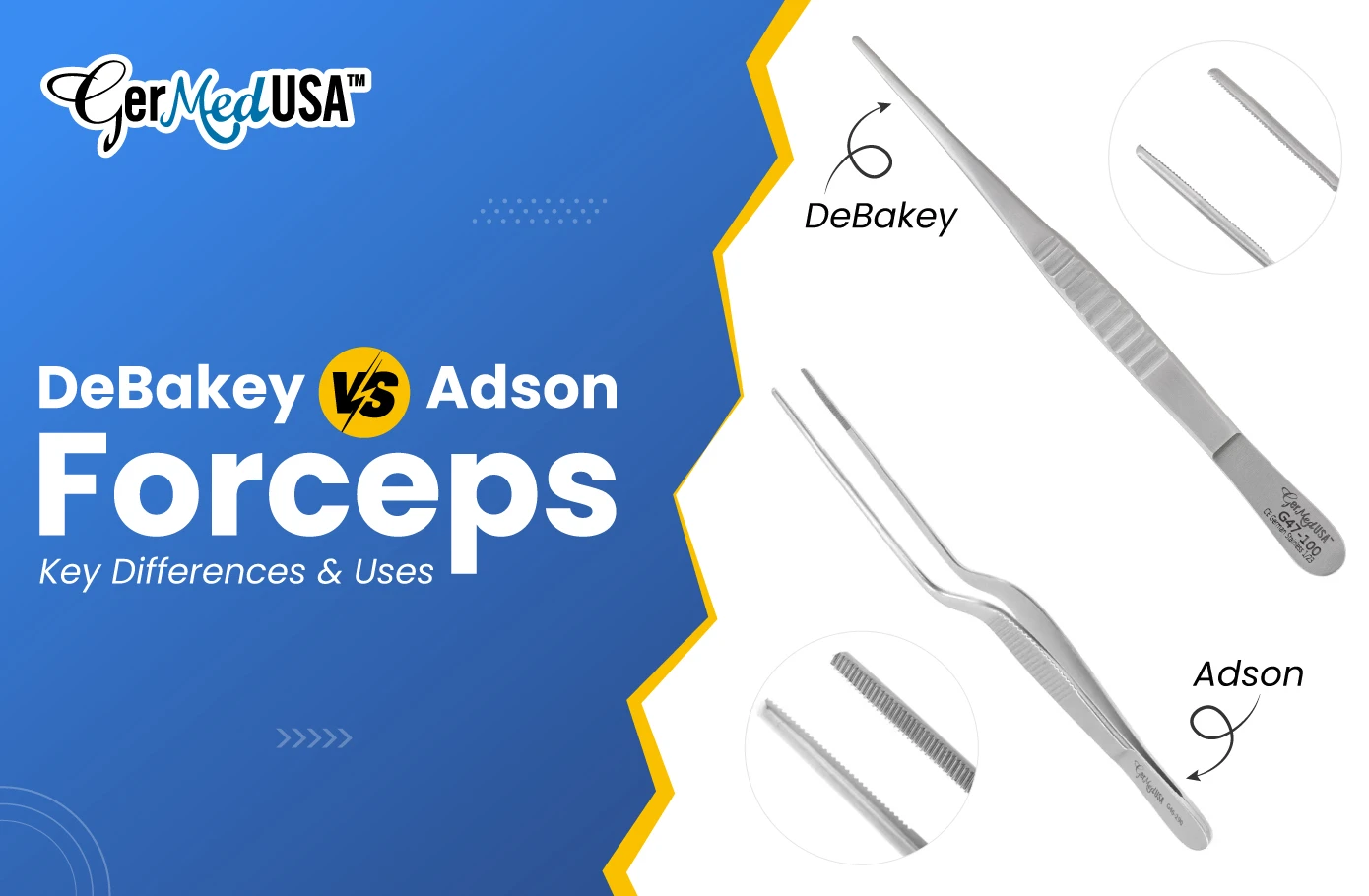
DeBakey and Adson forceps might look similar at first glance, but they are designed for different tissue-handling needs. DeBakey forceps have fine, longitudinal serrations designed to grip vascular and cardiac tissue gently, without causing trauma. Adson forceps, on the other hand, use interlocking teeth made to hold skin and fascia securely in place during wound closure.
DeBakey vs. Adson Forceps
|
Feature |
DeBakey Forceps |
Adson Forceps |
|
Tip design |
Fine, longitudinal atraumatic serrations |
Interlocking 1×2 and 2x3 teeth variants |
|
Primary tissue |
Blood vessels, cardiac and vascular tissue |
Skin, fascia, subcutaneous tissue |
|
Trauma risk on vessels |
Low, designed to avoid endothelial damage |
High, teeth can tear or crush thin-walled vessels. |
|
Typical length |
6 in to 9 1/2 in |
4 3/4 in |
|
Tip width |
1.5mm or 2.5mm |
Fine point, no flat gripping surface |
|
Handle options |
Standard or lightweight fenestrated |
Serrated, fenestrated, angled, or tying platform |
|
Best for |
Cardiovascular, thoracic, transplant, and microvascular surgery |
General surgery, skin closure, orthopedic and dermatologic procedures |
|
GerMedUSA price range |
$118.78 to $133.15 |
$28.74 to $92.73 depending on variant |
What Are DeBakey Forceps
DeBakey forceps are atraumatic tissue forceps designed to hold blood vessels and cardiac tissue without cutting into the vessel wall. Instead of teeth, the tip has fine, closely spaced longitudinal ridges, so the grip spreads pressure evenly across the tissue rather than concentrating it at just a few points. Dr. Michael DeBakey developed this design during his time at Baylor College of Medicine, and this atraumatic tip design is widely used for vascular and cardiovascular tissue handling.
GerMedUSA's DeBakey Vascular Tissue Forceps are available in four variants across two tip widths:
- 1.5 mm tip: Available in 6-inch and 8-inch lengths, plus a 6-inch lightweight fenestrated handle option. These variants are suited to fine dissection and handling of smaller vessels.
- 2.5 mm tip: Available in a 9 1/2-inch length for surgeons who need a slightly wider grip and extended reach when stabilizing deeper vascular structures.
Because the serrations are atraumatic, DeBakey forceps are commonly selected when delicate tissue requires controlled, atraumatic handling. Vessel walls, grafts, and friable cardiac tissue all fall into this category. The trade-off is that the same gentle grip gives up traction on tougher tissue like skin or fascia, which is where Adson forceps take over.
What Are Adson Forceps
Adson forceps are shorter, more compact instruments designed for controlled tissue grasping in a confined field, most often during skin and wound closure. The most common tip pattern is called 1x2 teeth, meaning one tooth on one jaw meshes with two teeth on the opposing jaw. This interlocking pattern is sometimes nicknamed a mouse tooth or rat tooth grip, and it holds tougher tissue securely without the forceps slipping mid-suture.
GerMedUSA's Adson Forceps with Teeth are available in seven 4 3/4-inch variants, including 1x2 and 2x3 tooth configurations, with options such as fenestrated, serrated, angled, tungsten carbide, and tying-platform designs.
The variations are designed for different handling and closure needs:
- Delicate fenestrated handle: Lightweight handling with a fenestrated grip.
- Serrated handle: Added grip on the handle.
- Tungsten carbide tipped: Carbide tip for added durability and grip.
- 2x3 teeth delicate: Finer tooth configuration for delicate tissue handling.
- Angled: Angled design for access to specific surgical sites.
- Tying platform: Designed to support suture tying and related closure work.
For procedures that call for a grip without interlocking teeth, GerMedUSA also offers Adson Forceps Serrated. These feature cross-serrated, atraumatic tips for a gentler hold:
- Bayonet dressing forceps: 8 1/4 inch length.
- Cross serrated atraumatic carbide grip: 4.75 inch length with a carbide grip.
Key Differences Between DeBakey and Adson Forceps
- Tip design: DeBakey forceps use fine longitudinal serrations; Adson forceps use interlocking 1x2 teeth (or, in the serrated line, cross-serrated atraumatic tips).
- Trauma risk: DeBakey tips distribute pressure to protect vessel walls; Adson teeth concentrate pressure to grip tougher tissue, which makes them better suited to tissue that benefits from a firmer grip than delicate vascular structures.
- Length: For GerMedUSA's DeBakey Vascular Tissue Forceps, available lengths range from 6 to 9 1/2 inches ; The Adson Forceps with Teeth featured by GerMedUSA are primarily 4 3/4 inches long, while other Adson configurations are also available in longer lengths, such as 6-inch variants.
- Specialty: DeBakey forceps are a cardiovascular and thoracic staple; Adson forceps show up across general surgery, orthopedics, and dermatology.
- When not to use DeBakey forceps: Avoid them for skin or fascia closure, where the atraumatic tip will not hold tough tissue securely during suturing.
- When not to use Adson forceps: Toothed Adson forceps are generally not preferred for delicate vascular or friable tissue because the teeth can puncture or traumatize the tissue.
How to Choose the Right Surgical Forceps for Your Practice
Choosing between DeBakey and Adson forceps starts with the tissue you need to handle. Think about three things: tissue type, grip, and access.
For Blood Vessels and Delicate Vascular Tissue
Choose DeBakey forceps when handling blood vessels, grafts, or cardiac tissue. Their fine longitudinal serrations provide grip while distributing pressure across the tissue rather than concentrating it at individual teeth. Longer variants can also give you more reach when working in deeper surgical fields.
For Skin, Fascia, and Tougher Soft Tissue
Choose Adson Forceps with Teeth when you need firm traction on tissue. The 1x2 teeth help hold skin edges and other tougher tissue during suturing and dissection, reducing the chance of the tissue slipping from the tips.
When You Need Grip Without Teeth
For fine soft tissue where the interlocking teeth may be too forceful, Adson Forceps Serrated could be a good alternative. Their cross-serrated atraumatic tips give grip without the pointed teeth, making them a gentler option for working close to tissue.
Consider the Length Too
The length of the forceps determines the extent of reach and hand control you have. The Adson forceps, which are usually 4 3/4 inches long, are good for close, controlled work. DeBakey variants are 6 to 9 1/2 inches, providing you with more alternatives when working around deeper vascular systems.
Summary
DeBakey and Adson forceps can both be used to handle tissue, but the distinct design of their tips makes them appropriate for quite different jobs. DeBakey forceps have fine longitudinal serrations and are used for the delicate manipulation of blood vessels, transplants, and other delicate tissues. Adson forceps with teeth allow a tighter grasp of skin, fascia, and harder soft tissues in suturing and dissection. If you prefer the compact handle and no interlocking teeth of the Adson forceps, the serrated Adson line gives a gentle alternative. The right choice comes down to the tissue you are handling, the grip you need, and how much reach the surgical field calls for.
GerMedUSA offers both DeBakey and Adson forceps in various configurations to give surgeons choices for delicate vascular handling, tissue gripping, suturing, and dissection.
Frequently Asked Questions
Can Adson forceps be used on blood vessels?
Adson forceps with teeth are not recommended for blood vessels. The interlocking teeth are designed to grip tougher tissue like skin and fascia, and that same grip can puncture or tear a vessel wall. For vascular work, use DeBakey forceps or the smooth Adson Forceps Serrated line instead.
What does the 1x2 in Adson forceps mean?
The 1x2 designation describes the tooth pattern at the tip: one tooth on one jaw fits between two teeth on the opposing jaw when the forceps close. This interlocking design is sometimes called a mouse tooth or rat tooth grip and is built to hold tissue firmly without slipping.
Are DeBakey forceps only used in cardiac surgery?
No. While DeBakey forceps are a cardiovascular and thoracic surgery staple, their atraumatic grip also makes them useful in transplant surgery, microvascular procedures, and any general surgery case where delicate tissue needs to be handled without crushing.
What length of DeBakey forceps should I choose?
Shorter lengths (6 in) suit fine dissection and smaller vessels close to the surface, while longer lengths (8 in to 9 1/2 in) give the reach needed for deeper vascular structures or thoracic access. Tip width follows the same logic: 1.5 mm for finer vessels, 2.5 mm for larger ones.
What is the main difference between DeBakey and Adson forceps?
The main difference is the tip design and intended tissue handling. DeBakey forceps have fine longitudinal atraumatic serrations designed for delicate vascular and soft-tissue handling, while toothed Adson forceps have interlocking teeth that provide a firmer grip on skin and other tissue during procedures such as wound closure.
What is the difference between Adson forceps and Adson Brown forceps?
Standard Adson forceps use the 1x2 tooth pattern described above. Adson Brown forceps use a multi-toothed tip, such as 7x7 or 9x9 teeth, to provide a secure, distributed grip for tissue stabilization.
Do Adson forceps come in a non-toothed version?
Yes. GerMedUSA's Adson Forceps Serrated replaces the interlocking teeth with cross-serrated atraumatic tips, giving surgeons the same compact Adson handling with a gentler grip for tissue that does not tolerate teeth marks.