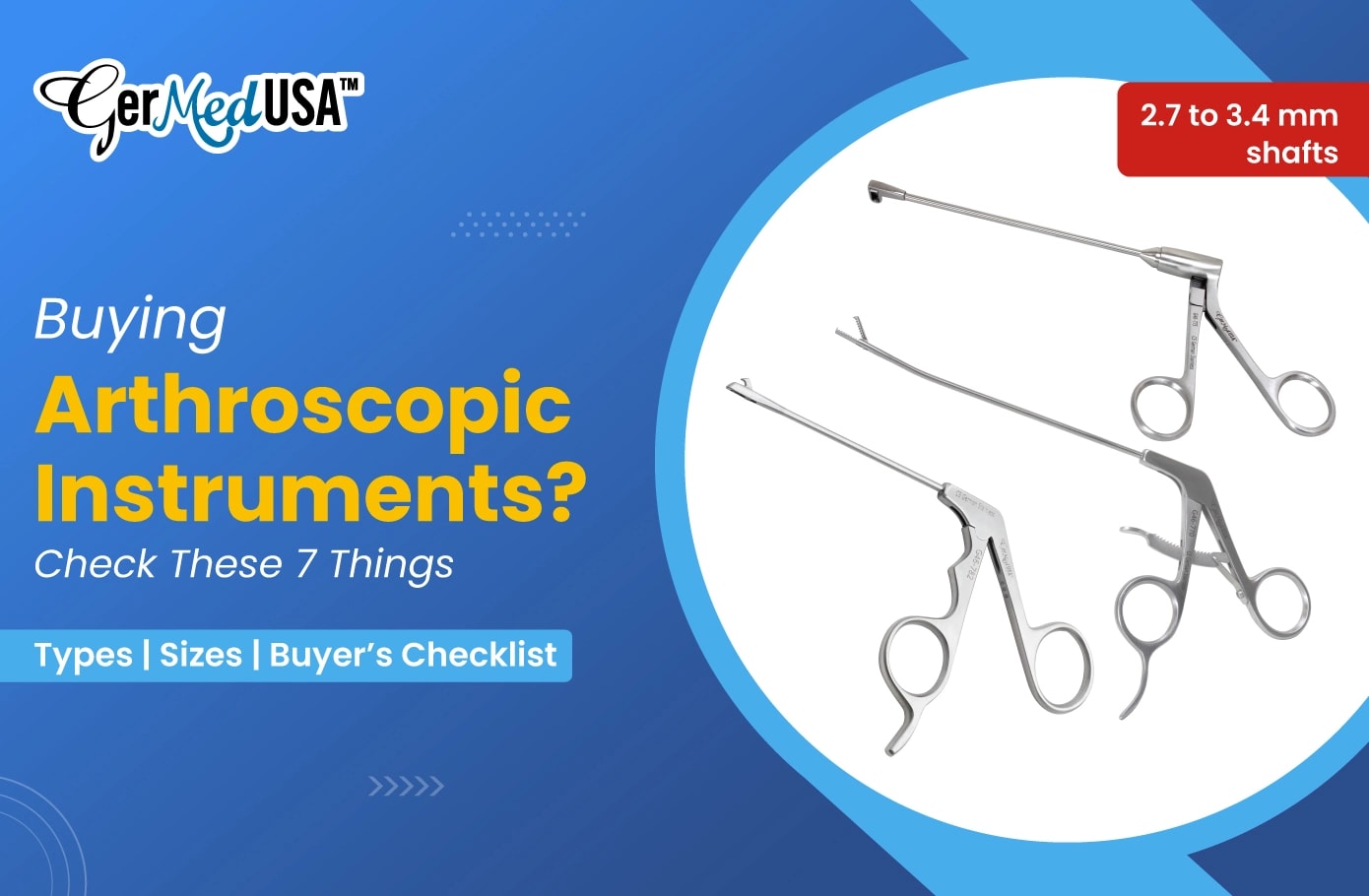
Arthroscopic surgical instruments are slim, precision tools that let a surgeon work inside a joint through very small incisions. Inside the joint, they probe, cut, grasp, and remove damaged tissue, all while a camera shows the surgical field on a monitor. Because everything passes through narrow portals, these instruments are built differently from the ones in a standard open tray.
If you buy or manage instruments for a surgical department, sterile processing, or a surgery center, the specs decide whether a tool fits your cases. Shaft diameter, bite size, handle design, and cleaning requirements all affect how an instrument performs and how it fits your workflow.
This guide covers the main types of arthroscopic instruments, common sizes, the differences between arthroscopic and open surgery instruments, and a practical buying checklist. The specifications referenced below are drawn from GerMedUSA’s Arthroplasty Instruments collection, featuring instruments for knee and joint surgery.
What Do Arthroscopic Surgical Instruments Do?
Most arthroscopic instruments handle one of four jobs:
- Probing and retracting: Hooks and probes are used to explore the joint and move tissue aside.
- Cutting: Scissors and knives trim and divide soft tissue.
- Grasping: Graspers and forceps hold tissue, pass suture, or collect samples.
- Resecting: Punches, curettes, and rasps remove and shape damaged or unwanted tissue.
Arthroscopic surgical procedures are performed in joints such as the knee and shoulder, and instrument choice depends on the joint, the working space, and surgeon preference. Instrument families are broadly similar across arthroscopic procedures, whether the goal is inspection or surgical repair. What tends to change is the tip style, the bite, and the length.
Types of Arthroscopic Instruments at a Glance
|
Instrument |
What it does |
|
Cuts and removes tissue with a wider bite, with the rotary tip angled for hard-to-reach areas |
|
|
Cuts, shapes, and removes tissue |
|
|
Grasper Mini Straight Tip 2.75mm 15° Up Curved Jaw Shaft with Handle |
Holds and manipulates tissue in narrow joint spaces |
|
Grasps tissue samples for biopsy |
|
|
Trims or removes soft tissue and reaches curved or restricted areas |
|
|
Probes, retracts, and manipulates soft tissue |
|
|
Cuts and trims soft tissue during arthroscopic procedures |
|
|
Combines knives, rasps, curettes, and hooks in a single-handle style |
|
|
Passes suture through tissue during arthroscopic repair |
|
|
Cuts and removes tissue in a controlled way with a wider bite |
Arthroscopic Instrument Sizes: What to Know
Arthroscopic instruments are small, designed to fit through narrow portals and cannulas.
In GerMedUSA's range, you'll find:
- Shaft diameters: 2.7 mm to 3.4 mm (the 4 mm on the handled hook is the hook size, not the shaft)
- Bite sizes: Starting at 1.6 mm
- Working shaft length: 10 cm for the hook punch and biopsy grasper
- Overall length: 9 1/4" for handled hooks
Sizes vary by brand and joint, so check the diameter and length against the cannulas and scopes you actually use in the OR.
Arthroscopic Instruments vs. Open Surgery Instruments
Open surgery instruments are designed to be seen and handled directly in a wide incision. Arthroscopic instruments are the opposite: they operate at the end of a long, thin shaft, so the tip and bite are very small. The surgeon is relying on the monitor and the sense of feel rather than direct vision. Long, narrow shafts and hinged parts can be harder to clean and inspect, which can make them more challenging for sterile processing staff.
What to Check Before You Buy Arthroscopic Instruments
Use these seven checks to match an instrument to your procedures, cannulas, and reprocessing workflow.
- Material: Look for corrosion-resistant stainless steel that will withstand repeated sterilization. GerMedUSA arthroscopic instruments are made from German-grade stainless steel.
- Tip and bite options: Match the bite size, tip angle, and tip style to your procedures. Ask whether straight, up-angled, and rotary tips are available in the size you need.
- Shaft length and diameter: Ensure the shaft passes smoothly through your cannulas and reaches the working depth that you require.
- Handle type: The finger ring handles and the triangle handles feel very different in the hand. Think about grip, control, and fatigue over the length of a case.
- Reusability and cleaning: GerMedUSA arthroscopic instruments are reusable and made from autoclavable stainless steel. They are supplied non-sterile, so reprocess them before first use according to your facility protocol. Instruments with open or detachable shafts are easier to clean, so flush shafts promptly after use and follow the manufacturer’s instructions and your sterile processing protocol.
- Warranty and repair: GerMedUSA backs forged instruments with a 5-year warranty; some instrument types carry shorter terms (see warranty page)
- Custom options: If a standard size or tip won't work for your procedure, then ask whether they can build to your requirements.
Frequently Asked Questions
What instruments are used in arthroscopy?
Common arthroscopic instruments are punches, graspers, biopsy forceps, scissors, hooks and probes, knives, curettes, and rasps. There are small sizes of all of them to work through narrow portals.
What is a punch used for in arthroscopic surgery?
A punch cuts and removes small pieces of tissue. It's the bite size and the tip angle that determine how precisely and how rapidly it can do that in a tight joint space.
What is the difference between graspers and biopsy forceps?
Graspers hold the tissue in position, and biopsy forceps take the sample. The Biopsy Grasper Forceps has a 10 cm shaft and a 2.7 mm serrated tip, with the serrations aiding the jaws in holding the tissue. The Grasper Mini has a 15° up-curved jaw for tighter angles.
What size are the arthroscopic instruments?
GerMedUSA shaft diameters range from 2.7 mm to 3.4 mm, with bite sizes as small as 1.6 mm and shaft lengths of 10 cm on the hook punch and biopsy grasper. The handled hooks are 9 1/4" long.
How are arthroscopic instruments any different from open surgery instruments?
They're slimmer with longer, narrower shafts and use small tips, which are designed to pass through a cannula. Surgeons work from a monitor image, so tactile feel and precise tips matter more.
What should hospitals be looking for when they're buying arthroscopic instruments?
Check the material, the tip and bite options, the shaft length, the handle type, reusability and cleaning requirements, the warranty, and any custom options. Then match each of those specs to the cannulas and procedures that you actually use.
Browse Arthroscopic Instruments at GerMedUSA
Ready to compare? You can browse the full arthroscopic and arthroplasty Instruments range (arthroscopic punches, hooks, graspers, biopsy forceps, etc.) or have a look at our wider range of Orthopedic Surgical Instruments.
Need a different bite, shaft length, or handle? Just get in touch with the GerMedUSA team, and we'll build you a custom arthroscopic instrument to your exact specifications.