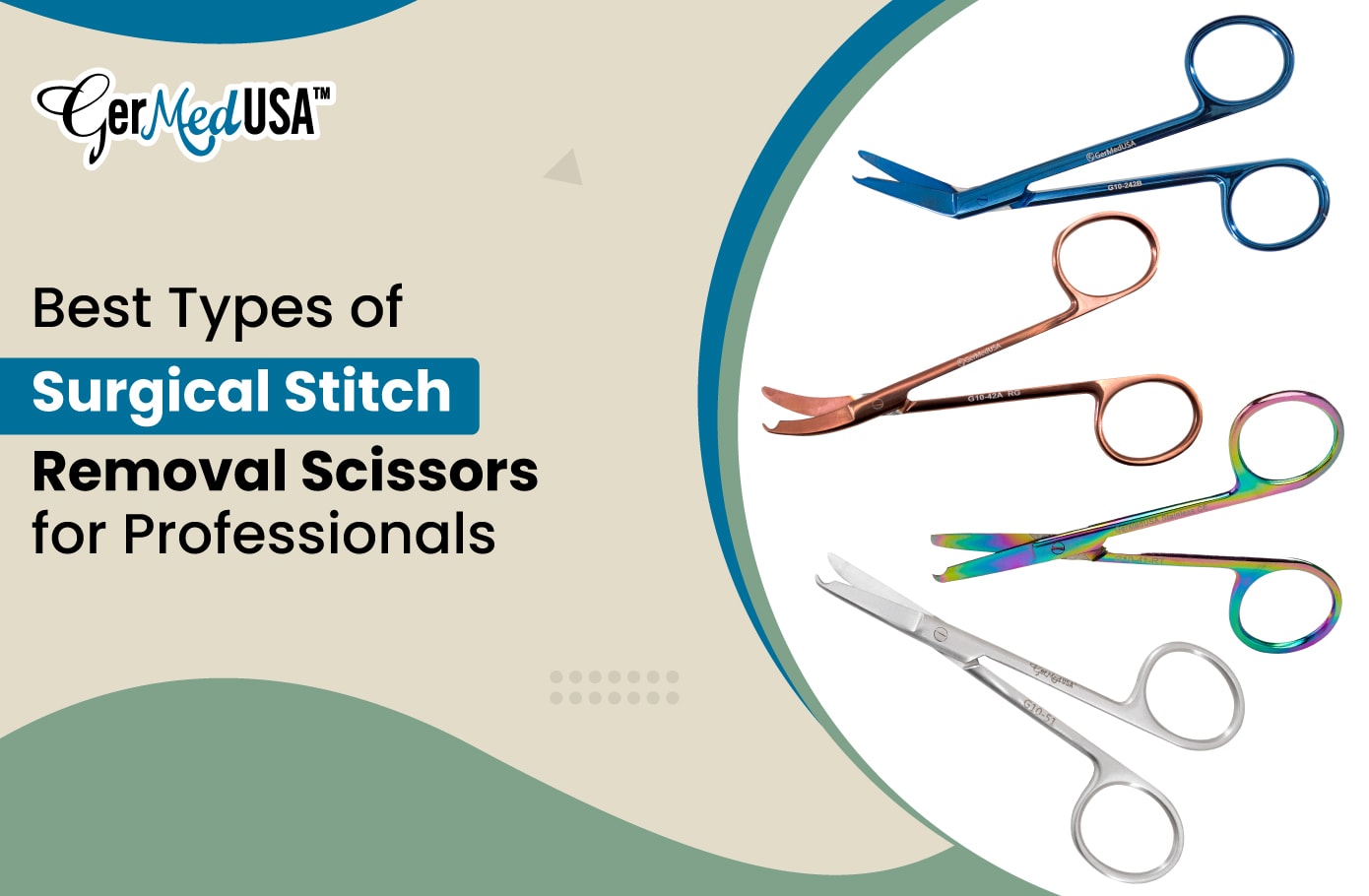
Surgical stitch removal scissors are used to remove sutures safely after wound healing. The suture removal scissors ensure clean suture cutting and reduce the patient's discomfort. A medical specialist, nurse, or surgeon can choose high-quality surgical scissors to enhance efficiency in surgical settings.
Surgical suture scissors are purpose-built for surgeons, doctors, and specialists’ post-operative management instrument kits. In this blog, we will discuss the types and variations of suture scissors.
Start reading to know more about surgical suture scissors.
What Are Surgical Stitch Removal Scissors?
Surgical stitch removal scissors or suture removal scissors are carefully designed surgical instruments. These scissors have sharp blades and a unique notch for efficient and precise stitch removal.
Suture scissors are essential to post-surgical care kits in hospitals and clinics. These scissors are available in curved and straight blades. So, surgeons can consider different settings or variations for multiple surgical procedures according to their needs.
Here are the key features of medical stitch scissors;
• Sharp and curved blades for efficient and precise suture cutting
• Notched design for better grip while cutting the suture
• Made up of stainless steel for durability
• Reusable after sterilization
• Ergonomic handles for better grip
Now, let’s take a look at the available stitch scissors types;
Types of Surgical Stitch Removal Scissors
Stitch or suture removal scissors are available in multiple types, variations, and sizes. Here is the list of available stitch removal scissors according to their types;
1: Spencer Stitch Scissors

Spencer stitch scissors are designed to cut the suture after wound healing. These scissors ensure the accuracy and precision of suture cutting during post-surgical care.
Here are the key features of Spencer Stitch Scissors;
• Made up of German stainless steel material
• Available in two sizes
• Rust-proof
• Sterilizable
Spencer Stitch Scissors are available in two variations, including;
• Spencer Stitch Scissors 3 1/2"
• Spencer Stitch Scissors 5."
2: Standard Stitch Scissors

Standard Stitch Scissors are versatile. These stitch scissors are designed to cut the sutures and trim tissues during suturing. Standard Stitch Scissors are made of German stainless steel.
Here are the key features of standard stitch scissors;
• German stainless steel material
• Unique structure
• Hooked shape tip
• Rust-resistant and reusable after sterilization
These scissors are available in the following variations or patterns;
• Stitch Scissors Curved 3 3/4" Fine Tips - Narrow Shoulder
• Stitch Scissors Curved 3 3/4" Fine Tips - Blunt Blades
• Short bent Stitch Scissors 3 1/2"
• Northbent Stitch Scissors 4 1/2"
• Standard Stitch Scissors 6 1/4"
3: Littauer Stitch Scissors

The design of Littauer Stitch Scissors is sleek, with dedicated patterns on the bottom blade. These patterns assist surgeons and medical professionals during suture cutting. These surgical scissors are ideal for trimming excessive sutures, tissue, and granulation.
Here are the key features of the Littauer Stitch Scissors;
• German stainless steel material
• Ideal instrument post-surgical care kit
• Rust-proof
• Boost high tensile strength
Littauer Stitch Scissors are available in the following variations;
• Littauer Stitch Scissors Straight 4 1/2"
• Littauer Stitch Scissors Straight 5 1/2"
4: Stitch Suture Removal Scissors, Color Coated Straight 5 1/2"
Stitch Suture Removal Scissors, Color-Coated Straight 5 ½", have a durable structure and delicate design. These surgical stitch removal scissors are highly reliable for cutting heavy sutures.
Here are the key features of Stitch Suture Removal Scissors, Color Coated Straight 5 ½";
• Requires minimum maintenance
• Manufactured with German stainless steel
• Reusable after sterilization
• Lightweight
• High tensile strength
These suture scissors are available in the following variations;
• Littauer Stitch Scissors 5 1/2" Blue Coated
• Littauer Stitch Scissors 5 1/2" Gun Metal Coated
• Littauer Stitch Scissors 5 1/2" Purple Coating
• Littauer Stitch Scissors 5 1/2" Straight Rainbow Coated
• Littauer Stitch Scissors 5 1/2" Straight Rose Gold Coated
5: Northbent - Shortbent Stitch Scissors 3 1/2", Color Coated
Northbent - Shortbent Stitch Scissors 3 1/2", Color-Coated, are ideal for major surgical procedures to cut sutures without any pain and discomfort to tissues. Here are the key features of these medical stitch removal scissors;
• Made up of German stainless steel
• Available in variations
• Color-coated
• Sterilizable
Northnbent - Shortbent Stitch Scissors are available in the following variations;
• Northbent / Shortbent Stitch Scissors 3 1/2" Blue Coated
• Northbent / Shortbent Stitch Scissors 3 1/2" Gun Metal Coated
• Northbent / Shortbent Stitch Scissors 3 1/2" Purple Coated
• Northbent / Shortbent Stitch Scissors 3 1/2" Rainbow Coated
• Northbent / Shortbent Stitch Scissors 3 1/2" Rose Gold Coated
6: Littauer Stitch Scissors 4 1/2" Straight - Color Coated
Littauer Stitch Scissors 4 1/2" Straight Color Coated are designed to remove the surgical suture during and after surgery. Here are the key features of Littauer Stitch Scissors 4 ½" Straight - Color Coated;
• Highly durable
• Ergonomic design for better grip while cutting suture
• Reusable after sterilization
Littauer Stitch Scissors 4 1/2" Straight - Color Coated are available in the following variations;
• Littauer Stitch Scissors 4 1/2" Straight Blue Coated
• Littauer Stitch Scissors 4 1/2" Straight Gun Metal Coated
• Littauer Stitch Scissors 4 1/2" Straight Purple Coated
• Littauer Stitch Scissors 4 1/2" Straight Rainbow Coated
• Littauer Stitch Scissors 4 1/2" Straight Rose Gold Coated
7: Littauer Stitch Scissors Super Sharp Tungsten Carbide

Littauer Stitch Scissors Super Sharp Tungsten Carbide are ideal surgical scissors for removing the suture. These scissors have a unique structure. Littauer Stitch Scissors Super Sharp Tungsten Carbide has the following features;
• Unreactive surface to chemical reactions
• Manufactured with German stainless steel
• High-quality and high-tensile
• Rustproof & resilient
Littauer Stitch Scissors Super Sharp Tungsten Carbide is available in the following variations;
• Littauer Stitch Scissors 3 1/2" Super Sharp Tungsten Carbide
• Littauer Stitch Scissors 4 1/2" Super Sharp Tungsten Carbide
• Littauer Stitch Scissors 5 1/2" Super Sharp Tungsten Carbide
8: Spencer Stitch Scissors 3 1/2" Color Coated
Spencer Stitch Scissors 3 1/2" Color Coated is used by surgeons, doctors, and medical professionals to cut sutures without damaging the skin. These surgical stitch removal scissors are color-coated.
Here are the key features of Spencer Stitch Scissors 3 1/2" Color Coated;
• The overall length of 3 ½” in all variations
• Color-coated
• Manufactured with German stainless steel
• Sterilizable
Spencer Stitch Scissors 3 ½” are available in the following variations;
• Spencer Stitch Scissors 3 1/2" Rainbow Coated
• Spencer Stitch Scissors 3 1/2" Gun Metal Coated
• Spencer Stitch Scissors 3 1/2" Rose Gold Coated
• Spencer Stitch Scissors 3 1/2" Blue Coated
• Spencer Stitch Scissors 3 1/2" Purple Coated
9: Stitch Scissors Color Coated

Stitch Scissors Color Coated are used in several surgical procedures to cut sutures. These scissors ensure a minimal risk of infection and damage to the tissues.
Stitch Scissors Color Coated have the following features;
• German stainless steel material
• Rust-proof
• Requires minimal maintenance
• Lightweight but durable
Here are the available variations of Stitch Scissors Color Coated;
• Stitch Scissors Stainless Steel 4 1/2" 45 Degree
• Stitch Scissors Stainless Steel 4 1/2" 45 Degree Blue Coated
• Stitch Scissors Stainless Steel 4 1/2" 45 Degree Gun Metal Coated
• Stitch Scissors Stainless Steel 4 1/2" 45 Degree Purple Coated
• Stitch Scissors Stainless Steel 4 1/2" 45 Degree Rainbow Coated
• Stitch Scissors Stainless Steel 4 1/2" 45 Degree Rose Gold Coated
10: Northbent - Shortbent Stitch Scissors 4 1/2" Color Coated
Northbent - Shortbent Stitch Scissors 4 ½" Color Coated are used in post-surgery management while removing or cutting the stitches. The ergonomic design of these surgical scissors offers a better grip while cutting stitches or removing sutures.
Northbent - Shortbent Stitch Scissors 4 ½" have the following features;
• German stainless steel material
• Rust-resistant
• Highly durable
• Steam sterilizable
• Available in multiple variations
These stitch removal scissors are available in the following variations or sizes;
• Northbent Stitch Scissors 4 1/2" Blue Coated
• Northbent Stitch Scissors 4 1/2" Gun Metal Coated
• Northbent Stitch Scissors 4 1/2" Rainbow Coated
• Northbent Stitch Scissors 4 1/2" Rose Gold Coated
11: Westcott Stitch Scissors 4"
Westcott Stitch Scissors 4" are versatile surgical suture removal scissors. These scissors are primarily used in post-operative management. The sharp curved blade of these scissors helps to remove the stitches, even from the eyelids, without any damage.
Here are the key features of Westcott Stitch Scissors 4";
• Made up of German stainless steel
• Micro pattern blades
• Spring action handle
• High tensile strength
12: Spencer Stitch Scissors 5" Color Coated
Spencer Stitch Scissors 5" Color Coated are manufactured to remove sutures with minimal damage to surrounding tissues. These surgical stitch removal scissors are available in multiple colors, allowing surgeons to distinguish quickly.
These color variations minimize the risk of infection by preventing the repeated use of the same scissors without proper sterilization. Spencer Stitch Scissors 5" has the following features;
• Available in multiple colors
• German-forged
• Finger ring handle design
• Blunt tip
Spencer Stitch Scissors 5" comes in the following variations;
• Spencer Stitch Scissors 5" Blue Coated
• Spencer Stitch Scissors 5" Gun Metal Coated
• Spencer Stitch Scissors 5" Purple Coated
• Spencer Stitch Scissors 5" Rainbow Color Coated
• Spencer Stitch Scissors 5" Rose Gold Coated
Surgical Stitch Removal Scissors Comparison Chart
Here is a comparison between different types of surgical stitch removal scissors.
| Instrument | Design focus | Key features |
| Spencer Stitch Scissors | Post-healing suture cutting | Precision cutting, rust-proof, and sterilizable |
| Standard Stitch Scissors | Suturing and tissue trimming | Hooked tip, narrow or blunt blade options, reusable |
| Littauer Stitch Scissors | Suture and tissue trimming with a patterned lower blade | Patterned blade support, high tensile strength, rust-proof |
| Stitch Suture Removal Scissors Color Coated Straight | Heavy suture removal | Lightweight, high tensile strength, minimal maintenance |
| Northbent Shortbent Stitch Scissors 3.5 inch Color Coated | Suture removal in surgical settings | Color-coated options, sterilizable, durable grip |
| Littauer Stitch Scissors 4.5 inch, Straight, Color Coated | Post-surgical suture removal | Ergonomic grip, durable structure, reusable |
| Littauer Super Sharp Tungsten Carbide | High-precision suture removal | Very sharp cutting edge, chemical resistance, rustproof |
| Spencer Stitch Scissors 3.5 inch Color Coated | Skin-safe suture cutting | Color variety, sterilizable, compact design |
| Stitch Scissors Color-Coated 45 degree | General suture cutting | 45-degree blade angle, lightweight, low maintenance |
| Northbent Shortbent Stitch Scissors 4.5 inch Color Coated | Post-surgery stitch removal | Ergonomic grip, multiple color options, durable |
| Westcott Stitch Scissors 4 inch | Delicate and fine suture removal | Spring action handle, micro-patterned blades, curved tip control |
| Spencer Stitch Scissors 5-inch Color Coated | General suture removal | Finger ring handle, blunt tip, color-coated handling |
Proper Care and Maintenance of Surgical Stitch Removal Scissors
Regular maintenance of surgical stitch scissors keeps them sharp, clean, and ready for repeated clinical use. A consistent maintenance routine also supports smoother handling during suture removal procedures.
• Clean the scissors immediately after use to remove blood, tissue, and suture debris.
• Use lukewarm water with a neutral pH cleaning solution during washing.
• Clean around hook tips and joints with a soft brush.
• Avoid harsh chemicals that may damage the stainless steel surface.
• Inspect the blades regularly for dullness, gaps, corrosion, or misalignment.
• Check hinge movement to confirm smooth opening and closing.
• Apply surgical instrument lubricant to the joint after cleaning and drying.
• Dry the scissors fully before sterilization or storage to prevent staining and rust.
• Sterilize according to the manufacturer’s recommended autoclave cycle.
• Keep the scissors in an open position during sterilization for better surface exposure.
• Avoid overcrowding instrument trays during autoclaving.
• Store the scissors in dry instrument trays or protective pouches.
• Use tip protectors to reduce accidental blade damage during storage.
• Keep stitch removal scissors separate from heavy surgical instruments.
• Use the scissors only for suture removal tasks to preserve cutting precision.
• Schedule routine maintenance and sharpening when cutting performance declines.
• Replace damaged or heavily worn scissors to maintain reliable clinical performance.
How to Select the Right Surgical Stitch Removal Scissors
Selecting the right surgical stitch removal scissors supports smoother suture removal, better handling, and long-term instrument performance. Here are some tips to select the right surgical stitch removal scissors.
• Choose scissors designed specifically for suture removal procedures.
• Select sharp-bladed scissors for clean and precise suture cutting.
• Consider hook-tipped scissors for easier suture lifting and removal.
• Pick a comfortable size and handle design for better control.
• Choose stainless steel or tungsten carbide scissors for durability.
• Check blade alignment and smooth hinge movement before purchase.
• Confirm the scissors are compatible with standard sterilization methods.
• Select instruments from reliable surgical instrument manufacturers.
High-quality stitch removal scissors offer lasting durability and greater efficiency during repeated clinical procedures.
Common Mistakes to Avoid While Working with Surgical Stitch Scissors
Improper handling and maintenance of stitch removal scissors may lead to reduced cutting precision, instrument damage, and less efficient suture removal during clinical procedures. Avoiding common handling and maintenance mistakes helps preserve the cutting performance and lifespan of suture removal scissors.
Here’s what to avoid.
• Using stitch removal scissors for materials other than sutures
• Skipping cleaning immediately after procedures
• Storing instruments while still wet
• Using harsh chemicals during cleaning
• Ignoring dull or misaligned blades
• Overloading sterilization trays during autoclaving
• Dropping instruments or stacking them with heavy tools
• Failing to lubricate the hinge area regularly
• Using damaged scissors during clinical procedures
• Neglecting routine inspection and maintenance schedules
Preventing these mistakes supports smoother suture removal, longer instrument life, and more comfortable handling for medical staff.
Why Should You Buy Surgical Stitch Scissors from GerMedUSA?
GerMedUSA, with more than three decades in the field, manufactures surgical instruments and focuses on consistent instrument quality and practical usability in clinical settings.
• Direct manufacturer with control over production and finishing
• Customization options available based on clinical needs and preferences
• Instruments designed for precision, comfort, and repeated clinical use
• Consistent quality checks across production stages
• Wide range of surgical scissors and related instruments available
Choosing GerMedUSA means access to instruments built with long-term usability in mind, along with the flexibility to tailor designs for specific surgical requirements
Final Words
Surgical stitch removal scissors ensure smooth and safe suture cutting after wound healing or during suturing. However, choosing the right size and variation of surgical suture scissors is essential for professionals to complete the post-operative management procedure efficiently.
That’s why several variations and sizes of suture scissors are available in the market. As a surgeon, if you cannot find the desired set or variation of stitch removal scissors, GerMedUSA is the place you should look for.
GerMedUSA Inc. offers a wide range of German stainless steel suture removal scissors for safe suture cutting. Our surgical instruments are designed to meet the highest medical standards. Explore our collection of surgical instruments today and experience the best in surgical precision!
FAQ’s
1. What makes surgical stitch removal scissors different from regular scissors?
Unlike regular scissors, surgical stitch removal scissors are designed with specialized tips and blades to cut sutures precisely without damaging the surrounding tissue.
2. Can surgical stitch scissors be reused?
Yes, high-quality stitch scissors are reusable after sterilization, ensuring long-term durability.
3. How do professionals choose the best suture removal scissors?
Medical professionals, surgeons, and doctors can consider the blade type, tip design, and handle ergonomics to match the specific surgical procedure. GerMedUSA offers a variety of suture scissors to meet different medical needs.
4. How should stitch removal scissors be cleaned?
They should be rinsed immediately after use, washed with a neutral-pH solution, and dried completely before sterilization.
5. What causes stitch removal scissors to lose sharpness?
Frequent use of non-suture materials, improper cleaning, or poor storage can reduce cutting performance over time.
6. How does tungsten carbide improve suture-scissors performance?
Tungsten carbide inserts increase edge retention, allowing longer cutting performance with less frequent sharpening needs.
7. What is the purpose of a spring joint vs. a screw joint?
Spring joints provide lighter resistance and quicker handling, while screw joints allow tighter adjustment and longer structural stability.
8. How is the cutting alignment of suture scissors verified during quality checks?
Alignment of suture scissors is checked by blade overlap testing under magnification to confirm smooth contact without gaps along the cutting edge.