Instrument quality has a direct bearing on surgical outcomes. A needle holder that slips, loses ratchet tension, or deforms a needle mid-suture creates risk at exactly the moment control matters most.
Therefore, relying only on high-quality surgical tools is crucial to ensure patient safety and better surgical outcomes. During surgery, surgeons use different instruments, and the quality of each is equally important.
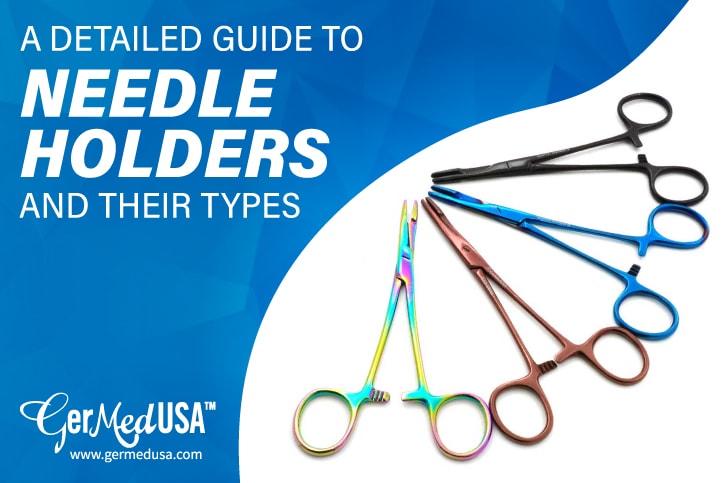
Needle holders are one of the most common tools in any surgical instruments list. Surgeons use them to hold the suture needles during the surgical procedure. Like the other tools, their precision and high quality contribute to successful surgeries.
In this blog, you will get a comprehensive insight into a needle driver, from its features to how to buy its premium quality. So let’s start learning about it!
What is a Needle Holder?
The needle holder is an essential component of every surgical tool kit. It looks like surgical scissors. It is also known as a needle driver or needle forceps. It helps the surgeon hold suture needles in place during the procedure.
Moreover, the surgical tool reduces the chances of slippage by firmly grasping the needles. Thus, the needles can easily reach the areas that are difficult to access during a surgical procedure. Next, let’s discuss the features of this surgical tool.
Although a needle driver looks like a hemostat, the needle driver vs hemostat comparison shows that each instrument has a different function during surgery.
Main Features
The surgical instrument has different components, which are as follows.
• Jaws
• Joints
• Shanks
• Finger ring handles
• Ratchet lock mechanism
Its jaws lie at the end of the fulcrum and can be narrow or thick. The shape of the jaws can be straight or curved. They can also be smooth or serrated, depending on their use. Tungsten Carbide inserts in the jaws provide more precision and control during surgery.
The handles can also be straight or curved. Additionally, its ratchet lock mechanism keeps the needles in place.
How to Hold a Needle Driver?
To hold a needle driver, place your thumb and ring finger in the instrument rings and keep your index finger along the shank. Now, use a light, controlled grip to guide the needle through tissue.
Holding a needle driver may look simple, but the real skill is in how you control the instrument. A secure grip gives you control over the needle while still allowing small, deliberate movements.
Your grip may also change depending on the type of needle holder, the size of the needle, the tissue being sutured, and the technique being used.
Here are some simple instructions about how to hold a needle driver like a pro.
Choose a Grip That Gives You Control
For a ring-handled needle driver, place your thumb and ring finger in the rings and rest your index finger along the shank. This gives you better control over small movements and helps guide the needle.
A palmed grip is another option. Here, the instrument rests more in the palm rather than placing the thumb through the ring. Some surgeons prefer this for quicker movements during certain suturing techniques.
Position the Needle for a Secure Hold
Place the needle about one third to one half of the way back from the tip, roughly perpendicular to the jaws. This gives you a firm hold while leaving enough of the needle available for controlled tissue passage.
Avoid gripping too close to the tip, as the needle may shift. Gripping too far back can make the needle harder to guide.
Release the Ratchet Without Losing Position
After passing the needle through tissue, release the ratchet while keeping the needle driver aligned. Use a small finger movement rather than repositioning your whole hand.
Good technique comes from a controlled grip, correct needle placement, and smooth movements rather than excessive pressure.
Common Handling Errors
A few habits can make suturing less controlled, including
- Gripping the needle too close to the tip: This can reduce control and allow the needle to move within the jaws.
- Overtightening the ratchet: Excessive pressure can damage the needle and put unnecessary force on the instrument.
- Rotating mainly from the wrist: Controlled movement from the hand and forearm can make needle rotation smoother and reduce awkward wrist movement.
As with any surgical instrument, handling technique develops through supervised practice and should be adapted to the specific needle holder, needle, tissue, and procedure.
Major types of Needle Holders
Before diving into the main types, it’s important to note that needle holder types and uses vary based on the surgical specialty and precision needed. Some are designed for microsurgeries, while others are suitable for general or orthopedic procedures. Knowing the different types of needle drivers helps surgeons select the right needle holder for specific tissues, which improves accuracy and patient safety.
Adson Needle Holder

The Adson needle holder fenestrated jaws 7" provides a firm grip over the suture needles during the surgical procedure. Plus, its clamp lock mechanism reduces the chances of slippage. The total length of the tool is 7 inches.
The instrument features horizontal serrations. In addition, it has joints, handles, and jaws. It is also made with German stainless steel, making it strong and durable.
Applications/ Uses:
• General surgery and soft tissue procedures
• Plastic and cosmetic surgery
• Skin and subcutaneous closures
Castroviejo Needle Holder

The Castroviejo Needle Holder Tungsten Carbide is perfect for use in microsurgery. The versatile tool has Tungsten Carbide inserts in its jaws. Further, it comes in three variations to give more options to surgeons for selection.
The surgical tool is reliable and sturdy. It is easily sterilizable; therefore, surgeons can use it multiple times after proper sterilization. On top of that, it doesn’t require much maintenance when appropriately used.
Applications/ Uses:
• Microsurgery and ophthalmic procedures
• Delicate vascular and plastic surgery suturing
• Fine tissue handling with precision control
Cooley Needle Holder

Cooley Needle Holders hold and move the suture needles and drivers while suturing the wound. These needle drivers have Tungsten Carbide inserts to add longevity. Moreover, they have delicate patterns with straight jaws and smooth shanks.
The surgical instrument is made of German stainless steel, which means it is resistant to rust and corrosion. The surface is also inert to many chemical reactions. Furthermore, it is simple to clean and reusable.
Applications/ Uses:
• Cardiovascular and thoracic surgery
• Soft tissue repair and internal suturing
• Durable for repeated use with medium to heavy needles
Derf Needle Holder

The Derf Needle Holder assists surgeons in holding the needles firmly. Surgeons use it in many surgical procedures, such as ophthalmic and plastic surgery. It has short, serrated jaws and a unique design to provide the atraumatic application.
The overall instrument length is 4 3/4". It is made with 100% medical-grade German stainless steel. That is why it is easily autoclavable and reusable. Furthermore, it is rust and corrosion-proof.
Applications/ Uses:
• Ophthalmic, plastic, and dental surgeries requiring fine sutures
• Precise control for small or delicate needles
• Compact and ergonomic design for tight or confined surgical areas
Mayo Hegar Needle Holder
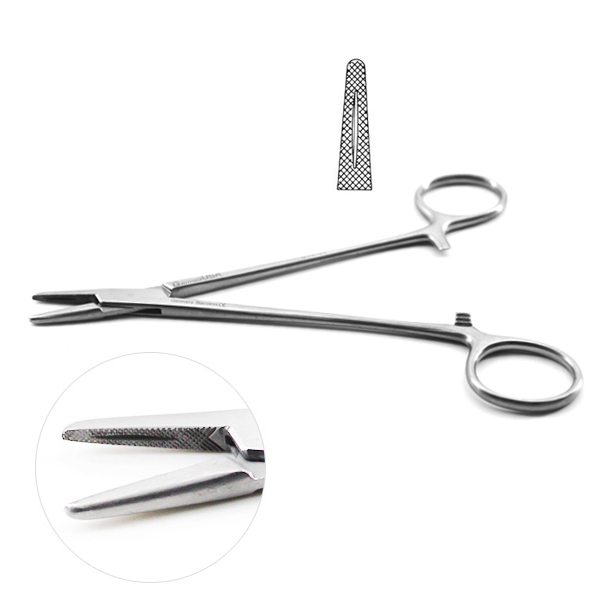
Surgeons use the Mayo Hegar Needle Holder to hold suture needles during various surgical procedures. The surgical tool is ideal for wound closure, offering a firm grip with its textured jaws. It comes in multiple variations due to its extensive use.
Additionally, the instrument features a clamp mechanism that will lock the suturing needles. It is steam sterilizable and reusable.
Applications/ Uses:
- Holding and guiding suturing needles during wound closure
- Driving needles through tissue with precision and control
- Assisting in knot tying during suturing
Olsen Hegar Needle Holder
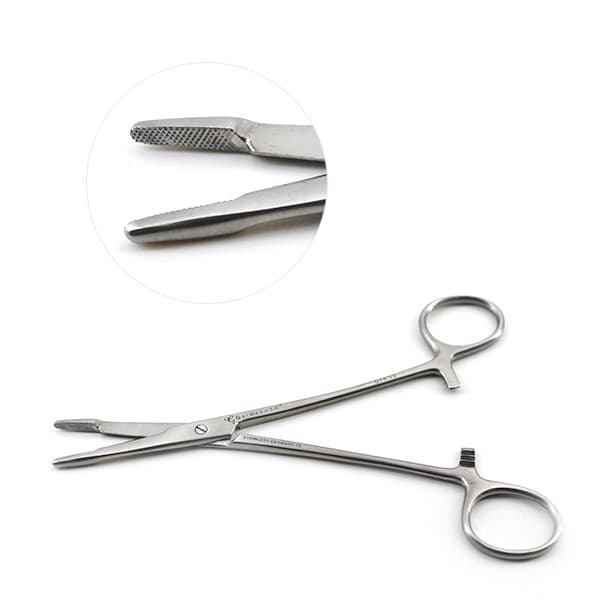
The Olsen Hegar Needle Holder combines a needle holder with scissors, allowing the surgeon to grasp the needle and cut suture without changing instruments. Its combined design can be useful when suturing and trimming are performed repeatedly during a procedure, though many surgeons still prefer dedicated surgical scissors where a cleaner cut matters.
Applications/Uses:
- Holding and guiding needles during suturing
- Cutting suture after needle placement
- Streamlining wound closure by combining two functions in one instrument
Crile Wood Needle Holder
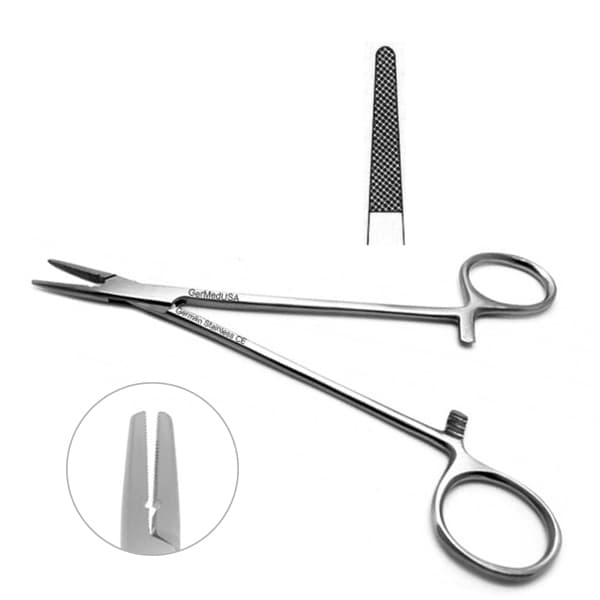
The Crile Wood Needle Holder features a slender design suited to controlled needle handling during suturing. Its narrow jaws provide a firm hold while allowing the surgeon to work with smaller needles and in areas where space is limited.
Applications/Uses:
- General soft tissue suturing and wound closure
- Handling small- to medium-sized suture needles
- Precise needle control in confined surgical fields
Common Uses of a Needle Holder
A surgical needle holder is used in a wide range of medical procedures. The following are some of the most common applications of this device:
- Holding and guiding the suture needle during wound closure.
- Providing control and stability in sensitive surgical manipulations.
- Reduce the risk of accidental needle injury or slippage.
- Assisting in microsurgery and ophthalmic suturing.
- Maintaining firm control of deep or hard-to-reach surgical sites.
Comparison of Common Surgical Needle Holder Types
Not all needle driver instruments function the same way. Some are designed for delicate microsurgery; others are meant for deep tissue suturing. Here’s a brief comparison of the most common needle holder types and their uses to help you understand what makes each one unique.
| Needle Holder Type | Best For / Typical Use | Jaw Design | Material | Key Feature |
| Adson | General surgery, skin & soft tissue | Serrated, fenestrated jaws | German Stainless Steel | Firm grip, moderate control |
| Castroviejo | Microsurgery, ophthalmic | Fine, smooth jaws, spring handle | Tungsten Carbide inserts | Precision control in delicate tissues |
| Cooley | Cardiovascular & thoracic | Straight, smooth or serrated | German Stainless Steel | Durable, corrosion-resistant |
| Derf | Ophthalmic, cosmetic, dental | Short, serrated jaws | German Stainless Steel | Compact, ergonomic for precision |
| Mayo-Hegar | Orthopedic, deep tissue closure | Textured heavy jaws | German Stainless Steel | Strong hold, heavy-duty suturing |
| Olsen Hegar | Suturing and suture cutting | Needle-holding jaws with integrated scissors | German Stainless Steel | Combines needle holding and suture cutting |
| Crile Wood | General soft tissue suturing | Slender, serrated jaws | German Stainless Steel | Firm grip with controlled needle handling |
Needle Holder Sizes and How to Select One
Choosing a needle holder is not only about the type of instrument. Its length, jaw size, surface, and material should match the needle and the surgical field.
Here are some tips to help you pick the right needle holder for your practice.
Match the Length to the Surgical Field
Choosing a length that fits the working depth gives the surgeon better control without unnecessary instrument movement.
Short needle holders work well for superficial procedures where the surgeon has direct access to the tissue. Longer instruments provide greater reach when suturing deeper or within body cavities.
Choose the Right Jaw Size
The jaws should suit the size and gauge of the needle. A heavy jaw can place too much pressure on a fine needle and potentially deform it. On the other hand, a fine jaw may not provide enough grip for a larger, heavier needle.
When Are Tungsten Carbide Inserts Worth It?
Tungsten carbide inserts can be a worthwhile option when repeated suturing demands a durable, precise jaw surface. They provide a firm grip and resist wear over repeated use. Needle holders with tungsten carbide inserts are traditionally identified by gold-colored finger rings, making them easy to distinguish from standard models.
Surgeons often prefer tungsten carbide instruments for their durable jaw surfaces, secure needle grip, and reliable handling during repeated suturing.
Smooth or Serrated Jaws?
Jaw texture also affects needle control. Serrated jaws provide additional grip and are useful when a secure hold is needed. Smooth jaws allow a gentler contact with the needle and are often preferred for delicate suturing.
You can browse our needle holder collection to compare different sizes and designs for various surgical applications.
How to Clean and Sterilize Needle Holders?
Good instrument care starts as soon as the needle holder is removed from the surgical field. Sterilization of surgical instruments involves cleaning and drying instruments first, followed by a validated process such as steam autoclaving.
Cleaning and sterilization should follow the instrument manufacturer’s instructions and your facility’s established reprocessing protocol.
The following are some steps involved in cleaning and sterilizing needle drivers after each use.
-
Rinse Before Debris Dries
Rinse the needle holder promptly after use to prevent blood, tissue, and other organic material from drying on the jaws or collecting around the box joint. Dried debris is harder to remove and can interfere with the instrument’s movement.
-
Clean the Jaws, Ratchet, and Joint
Needle holders can be cleaned manually or with an ultrasonic cleaner when the instrument and facility protocol permit it. Pay particular attention to the jaws, ratchet, and box joint, as debris can collect in these areas. Open and close the instrument during manual cleaning as directed by the manufacturer so cleaning reaches the working surfaces.
-
Dry Before Sterilization
After cleaning, rinse as directed and dry the instrument fully before packaging and autoclaving. Moisture left on the instrument can contribute to corrosion and may interfere with the sterilization process
-
Autoclave With the Ratchet Open
For steam sterilization, keep the ratchet fully open so steam can reach the instrument’s surfaces. Follow the manufacturer’s validated sterilization instructions for cycle type, temperature, exposure time, and drying.
One of the most common causes of premature instrument wear is storing a needle holder closed while it is still damp. Moisture trapped around the joint can promote corrosion and affect the instrument’s movement over time. Avoid storing instruments until they have been properly cleaned, dried, and processed according to your facility’s reprocessing protocol.
Want to Buy the Best Needle Drivers?
Like the other tools, the high quality of the needle holders is a significant concern for surgeons. For that reason, they explore different resources to find the best quality. However, with the availability of numerous manufacturers and suppliers of instruments, the selection of a reliable one is tricky.
But don’t worry anymore if you are looking for premium-quality tools; GerMedUSA could be your ideal choice. We have been a reputed manufacturer and supplier of surgical instruments for the last three decades.
Our surgical tools are made with German stainless steel, making them robust and long-lasting. Furthermore, they are resistant to rust and corrosion. Not only that, but they also have an inert surface for many chemical reactions. In addition, we also offer customization of surgical tools to meet our customers’ demands.
FAQ’s
Why do we offer multiple variations of a Needle Driver?
We offer different variations of this surgical tool, each varying in style, size, and feature. The availability of the different variations makes selecting the right tool easy for the surgeon.
Are Mayo Hegar Needle Holders sterilizable?
Yes, they are easily sterilizable. The preferred sterilization method for them is steam sterilization. Consequently, they are also reusable.
What are the different types of needle drivers used in surgery?
Adson, Castroviejo, Cooley, Derf, Mayo-Hegar, Olsen-Hegar, and Crile-Wood are among the most commonly used surgical needle drivers. Each is designed for a different combination of needle size, tissue type, and working depth, from Castroviejo for microsurgery through to Mayo-Hegar for heavy tissue closure. Olsen-Hegar is distinct in combining needle holding with an integrated suture-cutting edge.
How do surgeons choose the right needle holder instrument?
The choice would depend on the type of surgery, size of the needle, delicacy of the tissue, and personal preference. Understanding types of needle holders and their uses ensures precision and safety during suturing.
Can all surgical needle holders be sterilized and reused?
Yes, most needle holder instruments are designed to be autoclavable and reusable, constructed either from medical-grade stainless steel or with Tungsten Carbide inserts.
What are the main uses of a surgical needle holder?
The uses of needle holders include holding and guiding suturing needles. They help drive needles through tissue and assist in knot tying. They are also useful in microsurgery and help maintain control in deep or hard-to-reach surgical sites.