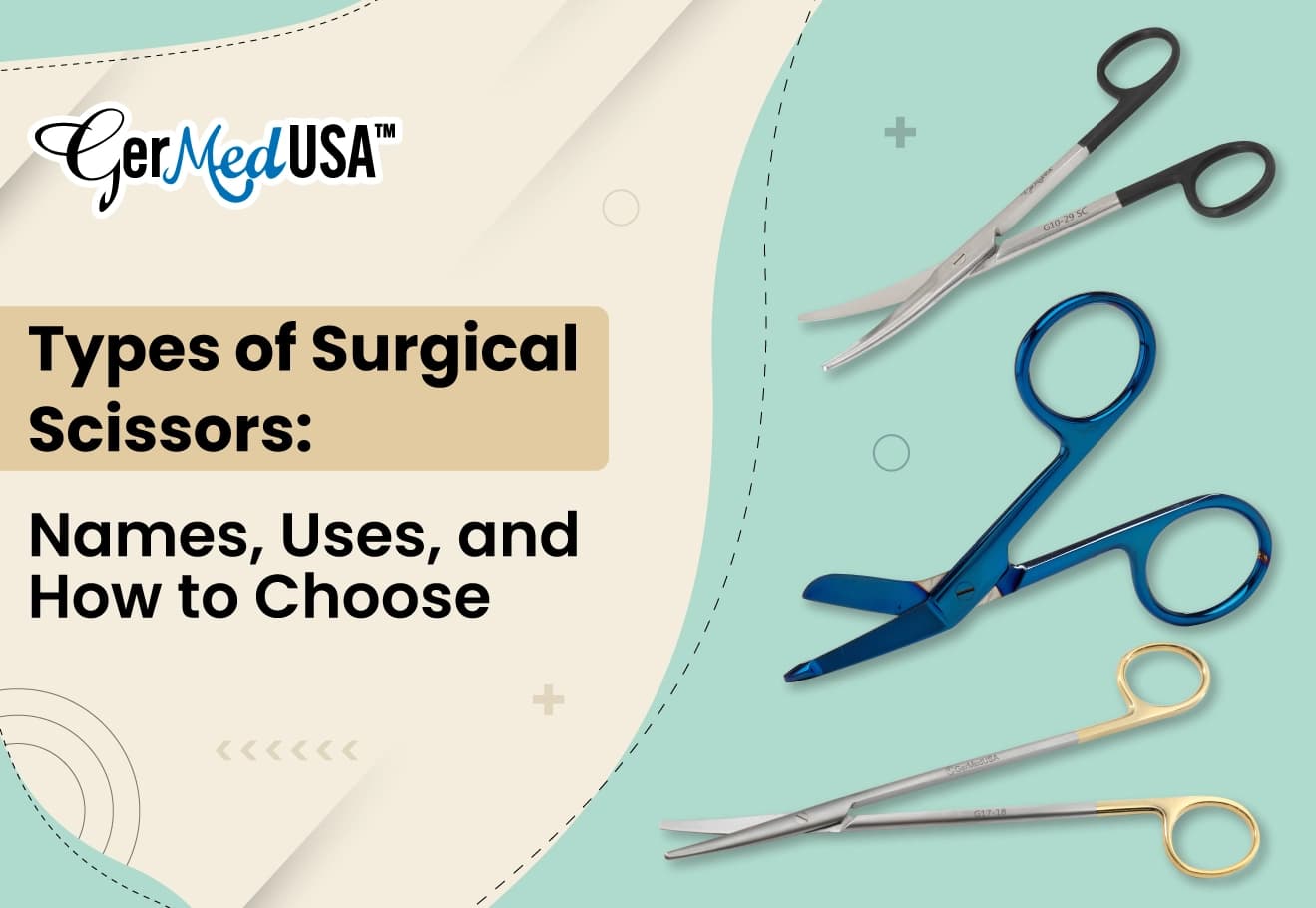
Surgical scissors are the most commonly used medical instruments. Medical scissors are known by several names depending on the setting and specialty, including surgical scissors, surgery scissors, and operating scissors, but the patterns themselves are consistent across the field.
Surgeons and healthcare professionals require specially designed scissors to cut and dissect surgical materials and bodily structures precisely. They can come in different sizes, shapes, and styles, each with a specific use–for particular surgeries.
Let’s explore the most common types of surgical scissors, their features, and their uses.
History and Evolution of Surgical Scissors
Medical scissors are a symbol of medical progression, and the advancements in surgery themselves triggered their history.
Modern surgeons use specialized scissors with precision-cutting edges, but earlier, they used fingers, teeth, or sharp rocks to cut or manipulate tissues.
This rooted in basic left the instrument the earliest method, and crude surgical instruments eventually supplanted medical surgical procedures.
Those initial pieces, which were made from bronze or iron, were much less precise than modern versions.
Surgical instruments had little innovation during the Middle Ages; the two instruments we can trace back to the Middle Ages are the string and the needle.
By the 18th and 19th centuries, great inventors had improved the world with more ideas and techniques.
Stainless steel, developed in the early 20th century, improved surgical scissors by introducing durable instruments with ease of sterilization.
Such transformation has actually contributed vastly to more effective surgeries and the ensuing outcomes, especially for patients.
Modern surgical scissors vary in design, each targeted at different types of surgical processes.
From eye surgery using highly precise iris scissors to the mainstay of dressing cuts with heavy bandage scissors, these instruments are invariably present and indispensable elements of the surgeon's toolbox.
Classification of Types of Surgical Scissors
Scissors can be classified into two main categories based on their design:
Handle Design
• Ring-handled Scissors
They are dedicated to the two usual varieties of surgical scissors. They are very similar to kitchen scissors but have only holes for the index and ring fingers. They are treasured for their smart control and single-handed working design, which makes them suitable for various agricultural tasks, such as simple cuttings and everyday chores.
• Spring-handled Scissors (Forceps scissors)
They use spring-loaded handles that pop up once pressure is released. This gives them great technical advantage for precise control and minimizing hand movement in medical fields such as ophthalmology and microsurgery.
Blade Design
The blade design of surgery scissors plays a crucial role in determining their functionality for specific surgical procedures. Here's a breakdown of some standard blade designs:
• Straight Blades
This is a blade that is used for soft tissue cutting. They have a clearly defined area for sawing.
Bending deep or narrow spaces, the rounded blade provides greater control and visibility. According to the intended use, they can be designed in different curvatures.
• Angled Blades
Angled blades provide improved access and visibility in tight surgical fields like curved blades. The angle of the blades can vary based on the specific application.
• Serrated Blades
One blade features serrated teeth for grasping and stabilizing tissue while cutting. These are commonly used in Mayo scissors for cutting sutures and bandages.
• Blunt Tip Blades
One blade has a blunt tip to minimize tissue damage during delicate procedures like tendon or ligament repair. This design is commonly seen in tenotomy scissors.
• Fine Pointed Blades
These sharp and delicate blades are ideal for meticulous dissection and separation of fragile tissues. They are part of dissecting scissors and iris scissors used in ophthalmic surgeries.
The specific combination of handle and blade design improves the function and suitability of surgical scissors for various surgical tasks.
The Four Most Common Types of Surgical Scissors

1. Mayo Scissors

Surgeons fully appreciate mayo scissors since they have a unique pattern for precise cutting and less tissue injury.
This dry ending makes them somewhat different from traditional knives with pointed tips.
Unlike other scissors, these scissors' tips are blunt to smooth their use in all close procedures when even a slight pinch is an unnecessary risk.
First, Mayo scissors can be straight or curved. Straight blades are perfect for treating near-surface tissues and suture removal, while curved blades impart deeper motion.
Both types share sharp edges, with the underside sharpened, which provides a better grip, often accompanied by a rough-ribbed lower blade.
Hence, the shears generate precise edges as the layers are dissected and quickly spread to part tiny structures. Thus, the specimens are separated accurately without any damage.
Their versatility has made Mayo scissors greatly useful in various operations, from general to the type that deals with the stomach, muscles, and uterus, among other organs.
We offer a wide range of German-forged Mayo scissors to meet the varying requirements of medical professionals.
2. Metzenbaum Scissors

Metzenbaum scissors are surgeons' cutting tools for intricate tissue dissection.
They come in different sizes and feature a unique design that features a long, narrow blade rather than a handle.
This procedure gives doctors access to better vision and control in narrow surgical areas.
The blades can be bent or straight but usually have a dull tip to avoid inevitable reception injuries.
Made of German stainless steel, the Metzenbaum scissors may have tungsten carbide inserts on the cutting edges to enhance their sharpness and durability.
These characteristics make perfect instruments for skilled surgeons to perform accurate work in plastic surgery, urology, and other specialties where reducing tissue destruction is one of the top priorities.
3. Iris Scissors

Iris scissors are omnivorous instruments skilled in accurately cutting and manipulating tissues.
Designed for use in ophthalmic surgery, their sharp blades and small sizes make them practical for maneuvering within the eye.
Moreover, their small size and sharp blades make them the preferred choice for many delicate procedures nowadays in other specialties.
They can be straight or round, and some have a blunt tip to be used quietly. Crafted out of an excellent grade of stainless steel, Iris scissors are strong and reliable and can be cleaned and sterilized for several uses.
Their distinctive features include miniature shapes, sharp blades, and the ability to provide surgeons with highly accurate and precise dissection control.
These scissors prevent any tissue damage that would cause problems in ophthalmology, plastic surgery, ENT surgery, and other delicate operations.
Our extensive catalog of Iris Scissors can meet all your needs for ophthalmic surgical scissors needs.
4. Operating Scissors

Operating scissors, a standard instrument in surgical kits, are used by surgeons.
Depending on their length (4.5 to 7 inches) and blade type (straight, curved, blunt, and precise), they can cut through different tissues during the operation.
Built from premium, sterilizable stainless steel, these scissors are top-notch.
Their sharp edges seamlessly cut yet soft tissues such as skin, muscles, and fascia.
Their versatility is limited to unknotting sutures and bandages and non-biological materials applied in surgeries.
Despite this fact, they are not surgical instruments suitable for delicate operations; there are some special forceps, like eye iris forceps, for the involved purposes.
Even though these scissors are multitasking, their specific design will vary according to the demanding needs of each procedure.
We at GerMedUSA offer these special scissors in multiple sizes and designs, all German-forged having precision craft.
Specialty Surgical Scissors by Procedure
The four patterns above cover most general surgical work, but many procedures call for an instrument shaped for one anatomical region. The types below are grouped by where and how they are used. Each links through to the full range.
Dissecting Scissors
Dissecting scissors separate tissue planes rather than cutting straight through them. They have slender, elongated blades that work in confined spaces, available in straight and curved profiles. Straight blades suit precise cuts on flat surfaces, while curved blades follow anatomical contours and keep the tip visible when working at depth. Our guide to dissecting scissors covers the variations in detail.
Common patterns include Mayo Dissecting Supercut Curved, Metzenbaum Dissecting Delicate Supercut Straight, Metzenbaum Tungsten Carbide Curved, Ragnell Dissecting Standard, and Mayo Dissecting Straight Left Hand.
Suture Scissors
Suture scissors are built for stitch removal rather than tissue cutting. The lower blade carries a small hook at the tip that slides beneath a stitch and lifts it clear, so the upper blade can cut without pressing into skin. Spencer, Littauer, Northbent-Shortbent, Ribbon, and Westcott are among the recognized patterns. For a fuller treatment of removal technique and instrument choice, see our guide to stitch removal scissors.
Tenotomy Scissors
Tenotomy scissors are fine instruments used on tendons, ligaments, and other delicate structures where a heavier blade would cause trauma. The blades are short relative to the shank, which gives control at the tip during precise work. Stevens and Westcott are the patterns most often stocked. Our article on tenotomy scissors sets out the variations.
Bandage Scissors
Bandage scissors have an angled blade with a blunt, flattened lower tip that slides under a dressing without catching skin. They are a ward and utility instrument rather than a theatre one, used for cutting dressings, tape, and cast padding. Lister and Knowles are the standard patterns.
Utility Scissors
Utility scissors handle non-biological material: suture thread, dressings, adhesive bandages, and cast padding. Using a tissue scissor for these tasks dulls the edge quickly, which is the main reason a dedicated utility pair belongs in every set. They are typically heavier built and less finely finished than dissecting patterns.
Neurosurgical Scissors
Neurosurgical scissors are used on brain tissue, spinal cord, and nerve structures, where the margin for error is smallest. The blades are fine and often bayonet-shaped or angled so the surgeon's hand stays clear of the operative view. Kelly ganglion curved and Adson ganglion straight are two of the patterns in regular use.
Harrington Scissors
Harrington scissors cut tissue lying deep beneath the surgical field, where visibility is limited and adjacent structures need protecting. The blade shape is designed so the cut can be placed accurately without the instrument obscuring the site. Flat and curved variants serve different depths and approaches.
Gynecological Scissors
Gynecological scissors are shaped for procedures on the female reproductive tract, including work on the uterine wall and cutting the umbilical cord after delivery. Blade profiles range from blunt to sharp depending on the tissue involved. Kelly uterine and Braun episiotomy scissors are two common examples.
Fergusson Abdominal Scissors
Fergusson abdominal scissors are used within the abdominal cavity, on the gut and surrounding tissue. The blade and handle proportions give the reach and leverage needed for cavity work without the instrument becoming unwieldy.
Dermal Scissors
Dermal scissors cut skin and are used across dermatological and minor surgical procedures. They are built more heavily than fine tissue scissors because skin offers more resistance than the tissue beneath it.
Cardiovascular and Thoracic Scissors
Cardiovascular and thoracic scissors are used on the heart, lungs, and great vessels. The thoracic cavity holds delicate tissue alongside major arteries and veins, so blade profiles are fine and often angled to give a clear view of the cutting edge. DeBakey Potts and Thorek are recognized patterns in this group.
Some of these patterns are also available with tungsten carbide inserts, identified by gold ring handles, which hold an edge longer under repeated use.
A Comparison of Common Surgical Scissors
Understanding the differences between various types of surgical scissors can help surgeons select the most suitable instrument for specific procedures. The table below highlights key features of the most commonly used surgical scissors:
|
Scissors Type |
Blade Design | Handle Type | Common Use | Special Features |
| Mayo Scissors | Straight/Curved | Ring-handled | General tissue cutting & sutures | Blunt tips for safe tissue handling |
| Metzenbaum Scissors | Straight/Curved | Ring-handled | Fine tissue dissection | Long, narrow blades for precision |
| Iris Scissors | Straight/Curved | Ring-handled | Ophthalmic & delicate surgeries | Small, sharp blades for accuracy |
| Operating Scissors | Straight/Curved/Blunt | Ring-handled | Cutting various tissues & bandages | Versatile but not for delicate operation |
| Spring-handled Scissors | Straight/Curved | Spring-handled | Microsurgery & precise control | Minimizes hand fatigue, enhances precision |
| Dissecting | Straight/Curved | Ring-handled | Separating tissue planes | Slender blades for confined spaces |
| Suture | Straight, hooked lower blade | Ring-handled | Stitch and suture removal | Hooked tip lifts the stitch clear |
| Tenotomy | Straight/Curved, fine | Ring or spring | Tendon and delicate tissue | Short blades, high tip control |
| Bandage | Angled, blunt lower tip | Ring-handled | Dressings, tape, cast padding | Blunt tip protects skin |
| Utility | Heavy, straight | Ring-handled | Non-biological materials | Preserves tissue scissors from dulling |
| Neurosurgical | Fine, angled or bayonet | Ring or spring | Brain, spinal cord, nerve | Shape keeps hand clear of the view |
| Gynecological | Blunt to sharp | Ring-handled | Uterine wall, umbilical cord | Profiles vary by tissue |
| Cardiovascular | Fine, angled | Ring-handled | Heart, lungs, great vessels | Precision near major vessels |
Materials Used in Different Types of Surgical Scissors
Surgical Scissors are usually made using German stainless steel or titanium alloys, which provide high-quality, sharp cutting edges and corrosion resistance. Apart from the non-stick ones, other top-notch scissors incorporate coatings or treatments to boost performance and durability.
How to Choose Surgical Scissors
Selecting a scissor comes down to four things: the tissue being cut, the depth of the field, the blade and tip configuration, and how the instrument sits in the hand.
- Tissue type sets the pattern. Dense tissue and fascia call for a Mayo; delicate tissue calls for a Metzenbaum; fine superficial work calls for Iris or a tenotomy pattern.
- Depth of field sets the length. Short instruments give more control near the surface, while longer patterns are needed to reach into the abdominal or thoracic cavity without the hand obstructing the view.
- Tip configuration sets the risk profile. Sharp/sharp gives precise incision, blunt/blunt separates tissue without cutting, and sharp/blunt is the general-purpose compromise. Blunt tips reduce the chance of inadvertent puncture near vessels or bowel.
- Handling is often overlooked. Ring size should suit the user's hand, since a poor fit causes fatigue across a long operating list. Left-handed instruments are available where standard blade orientation pushes the cut apart rather than drawing it together.
Care and Maintenance of Surgical Scissors
Rinse the instrument as soon as it leaves the surgical field, before blood and protein dry on the blades or collect around the box joint. Manual or ultrasonic cleaning follows, then thorough drying, then autoclaving with the instrument in the open position so steam reaches the joint and both blade faces.
Storing scissors closed and damp is the most common cause of premature corrosion and stiffness at the joint. Instruments should be inspected regularly for wear, misalignment, and early staining, since problems caught early can usually be corrected.
Sharpening should be carried out by a qualified instrument technician using proper equipment. A blade reground at the wrong angle will not shear correctly along its full length and can damage tissue. Our cleaning and sterilization guidance covers the full process.
Importance of Using the Right Surgical Scissors
A good choice of surgical scissors is essential for reaching accurate surgical results with minimum trauma and complications to the patients.
Surgeons need to make sure they use the right scissors for each procedure, which is decided by design, usability, and durability factors.
Conclusion
Understanding the range of surgical scissor patterns available, along with their materials and blade configurations, is a core part of selecting instruments that support safe and precise surgical care.
Familiarity with surgical scissors' various kinds, materials, and properties is an important component of healthcare professionals' ability to provide safe and excellent patient care.
At GerMedUSA, we offer surgical scissors made of German stainless steel, ensuring longevity, corrosion resistance, and easy sterilization. Browse our catalog for all your surgical instrument needs.
FAQs
Can surgical scissors be sharpened?
Yes. Surgical scissors are designed to be reground and returned to service, and professional sharpening extends the working life of the instrument considerably. The work should be carried out by a qualified instrument technician, since the bevel angle varies by pattern and must be restored exactly.
What are the benefits of titanium surgical scissors?
Titanium surgical scissors offer several benefits, including lightweight construction, corrosion resistance, and exceptional durability. They are ideal for use in demanding surgical environments.
What are the most common types of surgical scissors?
The most commonly used surgical scissors are Mayo, Metzenbaum, Iris, and operating scissors. Mayo scissors have heavy blades for cutting dense tissue and sutures, while Metzenbaum scissors are finer and longer for blunt dissection of delicate tissue. Iris scissors are short and sharp for precise superficial work, and operating scissors are the general-purpose theatre pattern, available in straight or curved form with sharp or blunt tip combinations. Many other patterns exist for specific procedures, including bandage, suture, tenotomy, and microsurgery scissors.
Why choose GerMedUSA Surgical Scissors?
GerMedUSA surgical scissors are manufactured from German stainless steel for durability, sharp blades for precision, and different variants to meet your specific surgical needs.
When should I choose blunt-tip vs sharp-tip surgical scissors?
Blunt-tip scissors are safer for handling tissues without causing damage, whereas sharp-tip scissors are used for precise cutting and dissecting delicate tissues.
How do I maintain surgical scissors to ensure longevity?
Regular cleaning, proper sterilization, lubrication, and timely sharpening are essential to maintain sharpness, prevent corrosion, and ensure optimal performance.
Can surgical scissors be used for multiple types of surgeries?
Yes, but each type of scissor is designed for specific tasks. Using the correct scissors for the intended procedure ensures precision and reduces tissue damage.
How do you sharpen surgical scissors?
Surgical scissors should be sharpened by a qualified instrument technician using proper equipment, not by hand in the practice. The process restores the original bevel angle along the full length of each blade, then realigns the blades at the pivot and tests the shearing action from the base to the tip. Correct sharpening matters clinically, because a blade that has been reground at the wrong angle will crush tissue instead of cutting it cleanly, and misaligned blades can bind or fail mid-procedure.
How to sharpen surgical scissors with a stone?
Stone sharpening should be done by a qualified instrument technician, who works the blade against a fine sharpening stone at its original bevel angle, drawing it from the pivot toward the tip in smooth strokes that follow the existing edge. The second blade is worked the same way, then the pivot tension is checked and the shearing action tested along the full blade length. The bevel angle is what makes this a specialist job: it varies by pattern, and grinding at the wrong angle leaves an edge that crushes tissue rather than cutting it. Instruments must be cleaned and re-sterilized after sharpening before returning to use.
Attempting the work with a household stone or file typically removes the factory bevel and shortens the instrument's service life. If scissors in your set have become dull, send them for professional servicing or replace them.